Talking cycles and repetition, this is probably the most prominent example everybody remembers from primary school, the water cycle. The rain comes down over the mountains filters through the stone, a spring, a creek, a river, a stream into the ocean, where it is picked up by clouds, ferries to the mountains.
A fairly romantic picture, but definitely a basic diagram explaining connection. Also it servers very well as a starting point for questions. For example for a six year old, why is the water salty in the ocean, but not the rain? How does the water know the way to the ocean? And why are the couds not drifting of to the moon?
This could go on and on developing into a full blown session on earthly systems, but it is all about the basic idea of a systemic concept. It is not about what happens it is more about what happens with it.
So or an ad explaining what a water supplier company does, this is a gold one, back to school.
Tampilkan postingan dengan label cycle. Tampilkan semua postingan
Tampilkan postingan dengan label cycle. Tampilkan semua postingan
Senin, 21 Februari 2011

Senin, 24 Januari 2011
Basel on Tracks - the Routine in the Distance
Some new data has com in from the GPS tracking project in Basel, Switzerland. Earlier a first group was blogged as 'Urbandiary Comparison Study' where we looked at the region and in 'Stadtraum - UrbanDiary' the focus was on the interaction area between participant and the city.

Image by single-blogs for urbanDiary / Basel-Stadt view, plotting all participants GPS track locations. Plotted using cartographica using Bing Maps in the background.
With the new data the focus shifts towards the individual movement in the urban area. This is in a next step also the unit that will be comparable to the existing urbanDiary London data sets.

Image by single-blogs for urbanDiary / Grossbaselview, plotting a single participant's locations. Plotted using cartographica using Bing Maps in the background.
Of much interest is of course the temporal structure of the everyday rhythm. The earlier London data was visualised as a graph plotted the number of track points per hour. This represented the amount of activity per each hour in 24 hour day. The resulting graph fitted well with the expected pattern, higlighting the rush hours, the lunch brake as well as elements of weekend activities following a different time structure. Examples HERE and updated HERE.

Image by single-blogs for urbanDiary / Distance-Time graph over 24 hours linear single participants. Plotted using DataGraph.
The strategy to visualise the Basel data in a similar graph has been changed a bit in order to create a stronger contextual sense. The Basel graphs are not based on number of track points, but on distance traveled from home. The home location is assumed to be a sort of start and end location in this case.
The graphs therefor trace the ebb and flows of the movement from and to home. On the way different activities paint the patterns and reoccurring activities enforce their pattern.

Image by single-blogs for urbanDiary / Distance-Time graph over 24 hours circular single participant. The 24 hours are here visualised around the circle, clockwise, with the distance plotted radial. Plotted using DataGraph and wound in photoshop - cheating I know but I needed a quick fix.
For the working week the distance starts to increase just after seven as participants leave the house to travel to work. Generally the distance then stays more or less the same through out the day, sometimes with a little bit of movement around the lunch time brake. In the evening the distance changes again until it is back to zero as the participants get back home.
However, the evening is compared to the morning a lot less precise. The morning fits across the sample into a timeframe of around one hour. The evenings are more divers and different activities take place opening a timeframe of up to four hours. This will need some more analysis in terms of how this timeframe divides into different activities and how it is structured. Maybe it is dominated by work activities and if there is more work people stay longer or there are groups of after work activities, such as fitness, shopping, socialising, and so on. Together with the interviews and the schedules it should be possible to entangle the structure.

Image by single-blogs for urbanDiary / Distance-Time graph over 24 hours circular multiple participants. The 24 hours are here visualised around the circle, clockwise, with the distance plotted radial. Plotted using DataGraph and wound in photoshop - cheating I know but I needed a quick fix.
Image by single-blogs for urbanDiary / Basel-Stadt view, plotting all participants GPS track locations. Plotted using cartographica using Bing Maps in the background.
With the new data the focus shifts towards the individual movement in the urban area. This is in a next step also the unit that will be comparable to the existing urbanDiary London data sets.
Image by single-blogs for urbanDiary / Grossbaselview, plotting a single participant's locations. Plotted using cartographica using Bing Maps in the background.
Of much interest is of course the temporal structure of the everyday rhythm. The earlier London data was visualised as a graph plotted the number of track points per hour. This represented the amount of activity per each hour in 24 hour day. The resulting graph fitted well with the expected pattern, higlighting the rush hours, the lunch brake as well as elements of weekend activities following a different time structure. Examples HERE and updated HERE.
Image by single-blogs for urbanDiary / Distance-Time graph over 24 hours linear single participants. Plotted using DataGraph.
The strategy to visualise the Basel data in a similar graph has been changed a bit in order to create a stronger contextual sense. The Basel graphs are not based on number of track points, but on distance traveled from home. The home location is assumed to be a sort of start and end location in this case.
The graphs therefor trace the ebb and flows of the movement from and to home. On the way different activities paint the patterns and reoccurring activities enforce their pattern.
Image by single-blogs for urbanDiary / Distance-Time graph over 24 hours circular single participant. The 24 hours are here visualised around the circle, clockwise, with the distance plotted radial. Plotted using DataGraph and wound in photoshop - cheating I know but I needed a quick fix.
For the working week the distance starts to increase just after seven as participants leave the house to travel to work. Generally the distance then stays more or less the same through out the day, sometimes with a little bit of movement around the lunch time brake. In the evening the distance changes again until it is back to zero as the participants get back home.
However, the evening is compared to the morning a lot less precise. The morning fits across the sample into a timeframe of around one hour. The evenings are more divers and different activities take place opening a timeframe of up to four hours. This will need some more analysis in terms of how this timeframe divides into different activities and how it is structured. Maybe it is dominated by work activities and if there is more work people stay longer or there are groups of after work activities, such as fitness, shopping, socialising, and so on. Together with the interviews and the schedules it should be possible to entangle the structure.
Image by single-blogs for urbanDiary / Distance-Time graph over 24 hours circular multiple participants. The 24 hours are here visualised around the circle, clockwise, with the distance plotted radial. Plotted using DataGraph and wound in photoshop - cheating I know but I needed a quick fix.
Rabu, 15 September 2010
Book - Behaviorology - Architecture and Time
Behaviorology is the title of the new Atelier Bow-Wow book. It is published by Rizzoli International Publications and contributors include Terunobu Fujimori, Meruro Washida, Yoshikazu Nango and Enrique Walker. A monograph one could say, summarizing most of the architecture projects they have realised. Bow-Wow is well known for their indepth research resulting in a series of books an use of diverse media, methods and techniques to investigate and create. In this sense a monograph is a bit a surprise.
It is almost, as is pointed out at A Daily Dose of Architecture, it seems as if this book has to be read together with the previous Bow Wow book Graphic Anatomy. In contrast to this most recent publication the focus of the previous publications lay on the representation of the projects in drawings. In this sense the drawings and te now published photographs could be read together. How they could fit together was beautifully demonstrated in the earlier reviewed book 'Portrait from Above' wich does employ a very similar 'research' strategy as the earlier Bow Wow 'Guide Books'.
However, there is more to this publication that a first impression might reveil and it starts with the title: Behaviorology, what does that mean?
For one, as the introduction explains, the term summarises the range of interests the Bow-Wow team has investigated and continues to investigate. This includes the focus on the interrelations between people and architecture, the architecture and the city and the city and people.
The second and probably more dramatic aspect to the term is the clear intention to establish an alternative to 'function' as the traditional modernist term. Modernist practice and definitions are critiqued and through out the work of Bow-Wow the wrestling with the omnipresence of this universal term of 'function'.
To create a new term and trying to establish it is a bold move, but the intentions are clear. It proposes an activity and subject centred new perspective. Probably a move so many practitioners and offices could buy into. This new perspective is of course something that is of course highlighted in this 'monograph' in all the project presented. And the introduction also outlines how te term can be applied on to three different areas of human beings, natural elements and buildings.
How this could work is the core of the introduction and the fundamental structure are the above mentioned three groups as areas of separate interests that will be tied together by the new term. Surprisingly these three groups could probably also be found in the modernist description of 'function' as a conception of the matter at hand.
Nevertheless, the term implies a new dimension of time at a much more dramatic scale than function ever did. Moreover function, probably intended to freeze time where behavior incorporates temporalas an active aspect. This in it selve is a paradigm shift and opens new dimensions for architecture and its positioning or role in everyday culture.
As an fundamental aspect Bow-Wow characterises this temporal aspect as a rhythmic repetition, very similar to what was proposed in 'Cycles in Urban Environments'. It proposes to use the routine and the cycle as a standard overarching the here proposed three main groups. This conception places the subjective and individual at the centre and establishes a 'bottom up' perspective. This conceptions could mark the departure from old practices and fuel the ongoing debate with a new term that ties in with a new understanding.
As described in the beginning and highlighted by others hoever, the book reads a bit in a rather confusing way, especially when it come to the presentation of the projects. We have been trained over the years by a flood of glossy monographs to read these marketing statements as a cultural contribution (which it was in some cases) and in this sense it is difficult to make an exception for the book a hand. The story is great and very convincing and we are all dreaming of this, a word, a term that would finally open the chains and lead on to new horizons.
Somehow the project documentation can not really live up to this promis. It is a good monograph, but it is still at large a glossy documentation of architecture. The photographs are very good and bring the objects across in vivid colours with shadows and lively materials. However, the settings are standard as are the situations. There are a handful of images that incorporate the behavior idea, but at large the images are standard architecture photography.
In this sense it remains unclear how this theoretical positioning of the approach ties in with the documentation of the body of work. The approach to integrate the two aspects is of course the best way to go about it, but at the same time the most problematic.
Nevertheless, it becomes clear while reading the texts that accompany the different chapters that this is definitely more than a simple monograph, but it is a process. I this sense this could be an actual milestone. An clearly the process will role on and might need further departures from terminologies, but could definitely lead on and in many sense it has already managed to incorporate the important dimension of time into the discussion and this could proof as a vital first step.
It is an unlikely contribution but things are not as they seem. It offers a lot of material for discussion and thought.

Image taken from Amazon / Front cover of the book Behaviorology by Atelier Bow-Wow published by Rizzoli International Publications
Bow-Wow, A., 2010. The Architectures of Atelier Bow-Wow: Behaviorology, Rizzoli International Publications.
Rabu, 16 Juni 2010
MyTime Interview - Hans Gubler Timekeeper for the Olympic Games 2012 in London
The Olympic Games are a global event of sport, writing history and making heroes by defining the athlete who performs best. In 2012 the games are being held in London and preparations are well under way. There is a lot of emphasis on the facilities and what can be seen at the moment is mainly building work on infrastructure and buildings. The building site over in Standford doesn't really look yet like a beautiful venue as we are shown on the renderings, but some of the buildings develop a recognizable shape.

Image taken from London2012.com / The Olympic Park taking shape on 2010-04-01. An aerial view of the Olympic Park looking north-west, with the Aquatics Centre in the foreground. The Olympic Stadium with the completed lighting towers is in the background.
In fact the Games actually return to London, after they were held here in 1948. Behind the scenes there is a lot of other preparation work going on. Part of this is the heart of the Games, the time keeping. Implementing this complicated system of measuring, processing and reporting accurate times is a big thing and has a lot of ties to other elements of the event. At this stage this involves Architecture, e.g. buildings as well as infrastructure, later on technical settings as well as communications. This means that Olympic time keeping is always part of the preparations from very early on. Omega as part of the Swatch group is once more responsible for keeping accurate times across the whole of the Olympic Games in 2012. The company has a very long tradition in sports event time keeping and were the first company to be appointed for the job by the IOC at the Los Angeles Olympic Summer Games in 1932. They had also done the earlier London Games in 1948 and in this sense the coming event marks 80 years since their first job and will be their 25th instance to keep official Olympic times.
Hans Gubler, who is heading the implementation team of Swiss Timing, the company responsible for the running and installation of the time keeping system, speaks to single-blogs about the job of keeping accurate times and implementing the icon of timekeeping. Of course of interest will be the development of the technology since the implementation of the photo finish camera ' at the 1948 London Games, but also we want to discuss implications of time and working with time in a broader sense.
----
single-blogs: Is it important to be on time?
Hans Gubler: Yes and No. It depends largely in what context the "being on time" is. In my job being on time is very important.
single-blogs: Omega was the first time keeping company to take the official times at the Olympic Games in Los Angeles in 1932. They have done the job ever since. Can you explain briefly the historic key elements?
Hans Gubler: In the 1930s timing was still done manually, meaning using stop watches. An early version photo finish camera already existed but was not approved by the sports federation in those days. Horse racing was the first sport where a photo finish device was put in place. With the arrival of the transistor in the 1940s things changed rapidly. Our company started to develop timing devices of which the key element was a high precision quartz. Electric photocells were used to start and stop timing at great precision. At the same time the photo finish technology was further developed and eventually homologated for Athletics and used for the first time at the London 1948 Summer Olympics. In the meantime conventional photo finish film technology has been taken over by computer technology. New technologies also include the introduction of transponders.

Image by Hans Gubler / Olympic Summer Games Beijing 2008 - Swimming, Finished.
single-blogs: You are working for one of the biggest temporal events globally, can you describe your current workplace?
Hans Gubler: I work with a team of 12 people (employed by my company) working at the Games organising committee's premises. Our activities comprise of planning our needs in the Olympic venues (cabling, space and power requirements, infrastructure for sports scoreboards) and testing results system software with all dependencies (Television, Integration with other systems).
Swiss Timing is a Timing, Scoring and Results services company within Swatch Group alongside with Omega, Longines, Swatch, Rado, Tissot and other watch brands. Watch brands such as Omega, Longines and Tissot use Swiss Timing's services for marketing/branding at sports events. Events range from the Olympics and Paralympics to World Championships, World Cups and many more events.
single-blogs: The Olympic Games have a cycle of four years, what are the 'cycles' for your company, how much time do you need for the setup?
Hans Gubler: The setup takes about 3.5 years. Whereof we are 2.5 - 3 years on site prior to the Games. The operational teams would show up on the venues for the test events and finally, for the Games.
single-blogs: How many Olympic sites have you already worked on and where was it?
Hans Gubler: My first Olympic games were the Winter Games in Sarajevo 1984, then Los Angeles 1984, Seoul 1988, Atlanta 1996, Sydney 2000, Athens 2004, Torino 2006 and Beijing 2008. In Sydney I started to be on site long term (three years), whereas before my involvement was only just for the Games periods.
single-blogs: Looking back, how have you come to this position and what is your background?
Hans Gubler: I come from an electrical engineering background and have worked in this industry for the last twenty years. At the time I looked for a job in a technical environment connected to sports.
single-blogs: What are the differences between personal and work related time aspects?
Hans Gubler: Personal time management can often be adjusted according to how one feels. Not all time lines have to meet a certain deadline. Professionally there are two levels. The first is to meet the time lines of deliveries (submission of documents, building/installing of equipment, testing of software) to synchronise with other parties' deliveries. The second is to be on time for a sports match or race and be precise in timing sports events (i.e. 100m dash race).

Image by Hans Gubler / Olympic Summer Games Beijing 2008 - Cycling Track, Start system.
single-blogs: In a rather global sense, how would you define time?
Hans Gubler: Time can be either described as space (amount of time) into which a quantity of work/activity is placed or the moment things are happening (from now to the end of race).
single-blogs: Are you using a specific definition of time you are using for your work?
Hans Gubler: Both of the above definitions. 1. Planning phase and 2. The actual event, measuring time of a sports performance.
single-blogs: How accurate can time measuring be?
Hans Gubler: Time accuracy can be indefinite however technical constraints and sports rules and regulations keep accuracy at bay. The highest resolution required in sports for the time being is 1/1000th of a second (i.e. Swimming), whereas Marathon over 42km only requires a resolution of 1 second.
single-blogs: Speaking of these completely different sports that the Olympics cover, how do they differ in terms of time keeping? Witch one is technically the most complicated to measure, witch one is the most beautiful?
Hans Gubler: Typically there are two categories namely timed sports and scored sports. Every sport has its own rules however some sports are very similar. Handball, Basketball, Football, Water polo for instance are scored sports where the match time is timed but the scores are relevant for the outcome. Swimming, Cycling and Athletics require precision timing for the ranking of the athletes. One of the most complicated sports is Modern Pentathlon where five disciplines are played in one day (Fencing, Swimming, Riding, Shooting and Running). It requires a lot of timing and scoring equipment and is intricate when it comes to networking all five sports for results compilation and live TV coverage.
Every sport has its beauty one way or another. My personal favourites to watch are Athletics and Tennis.
single-blogs: Do different conditions for time measuring exists. Say like weather conditions influence the performance? Does the wind direction influence the time?
Hans Gubler: Weather as such does not really influence time keeping (as long as the equipment is kept dry to function), however wind is a factor taken into account in Athletics where the sports rules stipulate a record time only to be recognised with wind from the back of < 2m/second. This rule applies to track races of up to 200m and long/triple jump. single-blogs: What are the different methods you are using to work with time?
Hans Gubler: Time is measured by using visual means (photo finish camera technology), infrared beams, wireless transponders, GPS technology

Image by Hans Gubler / Olympic Summer Games Beijing 2008 - Mountain Bike, Transponder.
single-blogs: Photo finishing and infrared are stationary technologies, GPS and wireless transponders can be mobile, are you tracking all the athletes and how accurate can this be?
Hans Gubler: GPS and wireless tanponders are mainly used for pisitionning of athletes during the race (intermediate times). The accuracy is no more than 1/10 of a second and is not recognised as the offical finish time.
single-blogs: Back in the Days of the 1932 Los Angeles Games hand-operated chronographs were used for timekeeping. What does it mean to work with time today, can you describe the context and support systems required?
Hans Gubler: The heart of time measurement is the high precision quartz used in custom made timing computers. Leading from there (depending on what sport and what precision is required), infrared beams, high resolution photo finish cameras, transponder systems or GPS systems are put in place.
single-blogs: Are you using the latest technology or even inventing them especially for the games or is the reliability of the system more important and you only implement well tested and proofed systems? What is the innovation you bring to the London 2012 Games?
Hans Gubler: New technology is developed not just for the Olympic Games but also for other high profile events such as World Championships and World Cups. Whether it would be for the Olympics or other events, new technology is tested thoroughly over periods of time in shadow (running alongside with existing and approved systems) before they are approved and used for events. Wireless systems are, in fact, not used in mission critical areas (i.e. data entries at Tennis, false start systems at Athletics etc.) since the risk of being interfered by other RF users is very high, especially in the Olympic Games.
New technology in London, as an example, is the timing of the mark roundings at Sailing using GPS.
single-blogs: Is there a backup system if the timing fails?
Hans Gubler: All crucial systems are equipped with back-up systems. The back-up system consists of a secondary system doing exactly the same as the primary system. A further contingency is the power supply back-up in form of an UPS (un-interrupted power supply).
single-blogs: Has there ever been an incident of hectic moments with failing systems at any of the Olympics you have worked for?
Hans Gubler: In Seoul 1988 the cartridge of the starting gun failed to go off properly in an Athletics race. The timing system was then immediately switched to the back up system. The race finished without a flaw.
Note - This is not the race mentioned above, just one of the races from Seoul in which Ben Johnson pitched a new world record over 100m.
single-blogs: The event relays on the time-measuring to determine the winners and this is turn is connected to a lot of investment and money in various areas. This presumably put a lot of pressure on the system and your job. Can you sleep at night?
Hans Gubler: The pressure is very high before and during the Games for both the operational and managing staff. The key element to meet and reduce risks is anticipation and proper preparation (thorough testing of software, hardware and procedures (exercising the switching to contingency systems)).
single-blogs: You are also responsible for the result tables and ranking system, how much time lies in between the event, the end of the event, and displaying it to the spectators on site and on TV? Is this immediate and solely determined by the technology or do you have to consult photos first and a judge takes a decision?
Hans Gubler: In the case of Athletics and Cycling the winner's time is displayed immediately (sub-second) on scoreboards and TV. The official time for the winner and all other athletes is read from the photo finish pictures and transferred into the results system as they are read. This process is a matter of a few seconds, unless there is a tie where careful analysis of the picture is required. In Swimming the times are officially recorded by the touch pads at the end of the pool.
single-blogs: Do you think different times exists, take place or could be constructed?
Hans Gubler: I think time could take place at a different level perhaps combined with space. There could also be different time levels that are still unknown to us.

Image by Hans Gubler / Olympic Summer Games Beijing 2008 - Athletics, Timing Room.
single-blogs: Would you say that there is something like a time legacy? In some sense one could argue that the times measured for the Olympics live on in the record books for generations of athletes to try and compete. What is the importance of the times in the context of the Olympics but also in general?
Hans Gubler: The legacy of times/records can be regarded as milestones for other athletes to live up to. They serve as comparison data to the media (press and TV/radio commentators). Times and records from the past also reflect the development of sports and increase in performance. A famous, if not the most famous, record was probably Bob Beamon's 8.90m in long jump during the Mexico 1968 Olympics. The record was only broken by Mike Powell with the distance of 8.95m in 1991.
single-blogs: You have lived in a lot of different countries, following the Olympic circus. Can you describe differences in time perception, usage or keeping from your experience?
Hans Gubler: There is definitely a difference of time perception depending on peoples' culture and mentality. A big difference I experienced between the Mediterranean (Athens) way of thinking (rather casual approach to managing time) versus the Chinese (Beijing) way of time approach (nothing is left unplanned, no surprises). The difficulty for us came with the former approach leaving little space for errors (planning, testing). Interestingly the former approach also meant more flexibility whereas the latter was much more rigid.
----
In an interview series single-blogs is looking closely at meaning and implications of time in everyday life situations. In the form of dialogs different aspects are explored, with the idea to highlight characteristics. The main interest is circling around the construction and implementation of different concepts of time between independent but related areas of activity, such as leisure and work, private and public, reality and virtual. This interview series will not be continuous, but more adhoc, so you might want to use the interview tag to catch up with the rest.

Image by Hans Gubler / Olympic Summer Games Beijing 2008 - Athletics, Finish camera.

Image taken from London2012.com / The Olympic Park taking shape on 2010-04-01. An aerial view of the Olympic Park looking north-west, with the Aquatics Centre in the foreground. The Olympic Stadium with the completed lighting towers is in the background.
In fact the Games actually return to London, after they were held here in 1948. Behind the scenes there is a lot of other preparation work going on. Part of this is the heart of the Games, the time keeping. Implementing this complicated system of measuring, processing and reporting accurate times is a big thing and has a lot of ties to other elements of the event. At this stage this involves Architecture, e.g. buildings as well as infrastructure, later on technical settings as well as communications. This means that Olympic time keeping is always part of the preparations from very early on. Omega as part of the Swatch group is once more responsible for keeping accurate times across the whole of the Olympic Games in 2012. The company has a very long tradition in sports event time keeping and were the first company to be appointed for the job by the IOC at the Los Angeles Olympic Summer Games in 1932. They had also done the earlier London Games in 1948 and in this sense the coming event marks 80 years since their first job and will be their 25th instance to keep official Olympic times.
Hans Gubler, who is heading the implementation team of Swiss Timing, the company responsible for the running and installation of the time keeping system, speaks to single-blogs about the job of keeping accurate times and implementing the icon of timekeeping. Of course of interest will be the development of the technology since the implementation of the photo finish camera ' at the 1948 London Games, but also we want to discuss implications of time and working with time in a broader sense.
----
single-blogs: Is it important to be on time?
Hans Gubler: Yes and No. It depends largely in what context the "being on time" is. In my job being on time is very important.
single-blogs: Omega was the first time keeping company to take the official times at the Olympic Games in Los Angeles in 1932. They have done the job ever since. Can you explain briefly the historic key elements?
Hans Gubler: In the 1930s timing was still done manually, meaning using stop watches. An early version photo finish camera already existed but was not approved by the sports federation in those days. Horse racing was the first sport where a photo finish device was put in place. With the arrival of the transistor in the 1940s things changed rapidly. Our company started to develop timing devices of which the key element was a high precision quartz. Electric photocells were used to start and stop timing at great precision. At the same time the photo finish technology was further developed and eventually homologated for Athletics and used for the first time at the London 1948 Summer Olympics. In the meantime conventional photo finish film technology has been taken over by computer technology. New technologies also include the introduction of transponders.
Image by Hans Gubler / Olympic Summer Games Beijing 2008 - Swimming, Finished.
single-blogs: You are working for one of the biggest temporal events globally, can you describe your current workplace?
Hans Gubler: I work with a team of 12 people (employed by my company) working at the Games organising committee's premises. Our activities comprise of planning our needs in the Olympic venues (cabling, space and power requirements, infrastructure for sports scoreboards) and testing results system software with all dependencies (Television, Integration with other systems).
Swiss Timing is a Timing, Scoring and Results services company within Swatch Group alongside with Omega, Longines, Swatch, Rado, Tissot and other watch brands. Watch brands such as Omega, Longines and Tissot use Swiss Timing's services for marketing/branding at sports events. Events range from the Olympics and Paralympics to World Championships, World Cups and many more events.
single-blogs: The Olympic Games have a cycle of four years, what are the 'cycles' for your company, how much time do you need for the setup?
Hans Gubler: The setup takes about 3.5 years. Whereof we are 2.5 - 3 years on site prior to the Games. The operational teams would show up on the venues for the test events and finally, for the Games.
single-blogs: How many Olympic sites have you already worked on and where was it?
Hans Gubler: My first Olympic games were the Winter Games in Sarajevo 1984, then Los Angeles 1984, Seoul 1988, Atlanta 1996, Sydney 2000, Athens 2004, Torino 2006 and Beijing 2008. In Sydney I started to be on site long term (three years), whereas before my involvement was only just for the Games periods.
single-blogs: Looking back, how have you come to this position and what is your background?
Hans Gubler: I come from an electrical engineering background and have worked in this industry for the last twenty years. At the time I looked for a job in a technical environment connected to sports.
single-blogs: What are the differences between personal and work related time aspects?
Hans Gubler: Personal time management can often be adjusted according to how one feels. Not all time lines have to meet a certain deadline. Professionally there are two levels. The first is to meet the time lines of deliveries (submission of documents, building/installing of equipment, testing of software) to synchronise with other parties' deliveries. The second is to be on time for a sports match or race and be precise in timing sports events (i.e. 100m dash race).
Image by Hans Gubler / Olympic Summer Games Beijing 2008 - Cycling Track, Start system.
single-blogs: In a rather global sense, how would you define time?
Hans Gubler: Time can be either described as space (amount of time) into which a quantity of work/activity is placed or the moment things are happening (from now to the end of race).
single-blogs: Are you using a specific definition of time you are using for your work?
Hans Gubler: Both of the above definitions. 1. Planning phase and 2. The actual event, measuring time of a sports performance.
single-blogs: How accurate can time measuring be?
Hans Gubler: Time accuracy can be indefinite however technical constraints and sports rules and regulations keep accuracy at bay. The highest resolution required in sports for the time being is 1/1000th of a second (i.e. Swimming), whereas Marathon over 42km only requires a resolution of 1 second.
single-blogs: Speaking of these completely different sports that the Olympics cover, how do they differ in terms of time keeping? Witch one is technically the most complicated to measure, witch one is the most beautiful?
Hans Gubler: Typically there are two categories namely timed sports and scored sports. Every sport has its own rules however some sports are very similar. Handball, Basketball, Football, Water polo for instance are scored sports where the match time is timed but the scores are relevant for the outcome. Swimming, Cycling and Athletics require precision timing for the ranking of the athletes. One of the most complicated sports is Modern Pentathlon where five disciplines are played in one day (Fencing, Swimming, Riding, Shooting and Running). It requires a lot of timing and scoring equipment and is intricate when it comes to networking all five sports for results compilation and live TV coverage.
Every sport has its beauty one way or another. My personal favourites to watch are Athletics and Tennis.
single-blogs: Do different conditions for time measuring exists. Say like weather conditions influence the performance? Does the wind direction influence the time?
Hans Gubler: Weather as such does not really influence time keeping (as long as the equipment is kept dry to function), however wind is a factor taken into account in Athletics where the sports rules stipulate a record time only to be recognised with wind from the back of < 2m/second. This rule applies to track races of up to 200m and long/triple jump. single-blogs: What are the different methods you are using to work with time?
Hans Gubler: Time is measured by using visual means (photo finish camera technology), infrared beams, wireless transponders, GPS technology
Image by Hans Gubler / Olympic Summer Games Beijing 2008 - Mountain Bike, Transponder.
single-blogs: Photo finishing and infrared are stationary technologies, GPS and wireless transponders can be mobile, are you tracking all the athletes and how accurate can this be?
Hans Gubler: GPS and wireless tanponders are mainly used for pisitionning of athletes during the race (intermediate times). The accuracy is no more than 1/10 of a second and is not recognised as the offical finish time.
single-blogs: Back in the Days of the 1932 Los Angeles Games hand-operated chronographs were used for timekeeping. What does it mean to work with time today, can you describe the context and support systems required?
Hans Gubler: The heart of time measurement is the high precision quartz used in custom made timing computers. Leading from there (depending on what sport and what precision is required), infrared beams, high resolution photo finish cameras, transponder systems or GPS systems are put in place.
single-blogs: Are you using the latest technology or even inventing them especially for the games or is the reliability of the system more important and you only implement well tested and proofed systems? What is the innovation you bring to the London 2012 Games?
Hans Gubler: New technology is developed not just for the Olympic Games but also for other high profile events such as World Championships and World Cups. Whether it would be for the Olympics or other events, new technology is tested thoroughly over periods of time in shadow (running alongside with existing and approved systems) before they are approved and used for events. Wireless systems are, in fact, not used in mission critical areas (i.e. data entries at Tennis, false start systems at Athletics etc.) since the risk of being interfered by other RF users is very high, especially in the Olympic Games.
New technology in London, as an example, is the timing of the mark roundings at Sailing using GPS.
single-blogs: Is there a backup system if the timing fails?
Hans Gubler: All crucial systems are equipped with back-up systems. The back-up system consists of a secondary system doing exactly the same as the primary system. A further contingency is the power supply back-up in form of an UPS (un-interrupted power supply).
single-blogs: Has there ever been an incident of hectic moments with failing systems at any of the Olympics you have worked for?
Hans Gubler: In Seoul 1988 the cartridge of the starting gun failed to go off properly in an Athletics race. The timing system was then immediately switched to the back up system. The race finished without a flaw.
Note - This is not the race mentioned above, just one of the races from Seoul in which Ben Johnson pitched a new world record over 100m.
single-blogs: The event relays on the time-measuring to determine the winners and this is turn is connected to a lot of investment and money in various areas. This presumably put a lot of pressure on the system and your job. Can you sleep at night?
Hans Gubler: The pressure is very high before and during the Games for both the operational and managing staff. The key element to meet and reduce risks is anticipation and proper preparation (thorough testing of software, hardware and procedures (exercising the switching to contingency systems)).
single-blogs: You are also responsible for the result tables and ranking system, how much time lies in between the event, the end of the event, and displaying it to the spectators on site and on TV? Is this immediate and solely determined by the technology or do you have to consult photos first and a judge takes a decision?
Hans Gubler: In the case of Athletics and Cycling the winner's time is displayed immediately (sub-second) on scoreboards and TV. The official time for the winner and all other athletes is read from the photo finish pictures and transferred into the results system as they are read. This process is a matter of a few seconds, unless there is a tie where careful analysis of the picture is required. In Swimming the times are officially recorded by the touch pads at the end of the pool.
single-blogs: Do you think different times exists, take place or could be constructed?
Hans Gubler: I think time could take place at a different level perhaps combined with space. There could also be different time levels that are still unknown to us.
Image by Hans Gubler / Olympic Summer Games Beijing 2008 - Athletics, Timing Room.
single-blogs: Would you say that there is something like a time legacy? In some sense one could argue that the times measured for the Olympics live on in the record books for generations of athletes to try and compete. What is the importance of the times in the context of the Olympics but also in general?
Hans Gubler: The legacy of times/records can be regarded as milestones for other athletes to live up to. They serve as comparison data to the media (press and TV/radio commentators). Times and records from the past also reflect the development of sports and increase in performance. A famous, if not the most famous, record was probably Bob Beamon's 8.90m in long jump during the Mexico 1968 Olympics. The record was only broken by Mike Powell with the distance of 8.95m in 1991.
single-blogs: You have lived in a lot of different countries, following the Olympic circus. Can you describe differences in time perception, usage or keeping from your experience?
Hans Gubler: There is definitely a difference of time perception depending on peoples' culture and mentality. A big difference I experienced between the Mediterranean (Athens) way of thinking (rather casual approach to managing time) versus the Chinese (Beijing) way of time approach (nothing is left unplanned, no surprises). The difficulty for us came with the former approach leaving little space for errors (planning, testing). Interestingly the former approach also meant more flexibility whereas the latter was much more rigid.
----
In an interview series single-blogs is looking closely at meaning and implications of time in everyday life situations. In the form of dialogs different aspects are explored, with the idea to highlight characteristics. The main interest is circling around the construction and implementation of different concepts of time between independent but related areas of activity, such as leisure and work, private and public, reality and virtual. This interview series will not be continuous, but more adhoc, so you might want to use the interview tag to catch up with the rest.
Image by Hans Gubler / Olympic Summer Games Beijing 2008 - Athletics, Finish camera.
Jumat, 21 Mei 2010
Book - Cycles in Urban Environments
Instead of a book review, for once this is a book promotion. My recent book (2010) Cycles in Urban Environments: Investigating Temporal Rhythms published by LAP is now available on amazon online. The content is based on my research work for my Masters Thesis at the Bartlett School of Architecture. In two parts this publication looks into temporal aspects of the urban environment, from individual movement to collective activities and observes cultural or socia constraints as well as possibilities. The second part of the book looks into possible applications in the context of a project for a floating city in the Thames Estuary.

Image by Fabian Neuhaus taken from Cycles in Urban Environment / Friday 07th, Cycles Memory, the London 7/7 Memorial.

Image by Fabian Neuhaus taken from Cycles in Urban Environment / Tuesday 04th, Cycles Season, Seasonal Life Cycles.
Published on: 2010-05-04, Original language: English, Binding: Paperback, 180 pages
Cycles in Urban Environment This book explores the appearance and impact of cycles in urban surroundings and, in a second stage, their potential for an urban proposition. Cycles appear in any part of life. Examples can be found in time, economics, environment or social activities. Cycles appear through a wide range of scales and often without referring to them. Investigating these patterns in a spatio-social context makes sense regarding urban planning and urban sustainability as well as from a theoretical point of view in the sense of a spatial-temporal concept. The first part, is designed as an observational study in an existing urban environemnt, where as the second part, is an application of some of the findings of part one in a proposal for a floating city in the Thames Estuary. Both elements are approached as one process and influence one another. Four included essays with a specific focus on a related topics help to set a wider context and guide the debate.
Neuhaus, F., 2010. Cycles in Urban Environments: Investigating Temporal Rhythms, LAP Lambert Academic Publishing.
Image by Fabian Neuhaus taken from Cycles in Urban Environment / Friday 07th, Cycles Memory, the London 7/7 Memorial.
Image by Fabian Neuhaus taken from Cycles in Urban Environment / Tuesday 04th, Cycles Season, Seasonal Life Cycles.
Published on: 2010-05-04, Original language: English, Binding: Paperback, 180 pages
Cycles in Urban Environment This book explores the appearance and impact of cycles in urban surroundings and, in a second stage, their potential for an urban proposition. Cycles appear in any part of life. Examples can be found in time, economics, environment or social activities. Cycles appear through a wide range of scales and often without referring to them. Investigating these patterns in a spatio-social context makes sense regarding urban planning and urban sustainability as well as from a theoretical point of view in the sense of a spatial-temporal concept. The first part, is designed as an observational study in an existing urban environemnt, where as the second part, is an application of some of the findings of part one in a proposal for a floating city in the Thames Estuary. Both elements are approached as one process and influence one another. Four included essays with a specific focus on a related topics help to set a wider context and guide the debate.
Neuhaus, F., 2010. Cycles in Urban Environments: Investigating Temporal Rhythms, LAP Lambert Academic Publishing.
Rabu, 24 Februari 2010
How Predictable is our Movement?
Physicist Albert-László Barabási, well known for his work on network theory, has tuned his attention in a recent paper to the human movement. In the latest issue of Science 19 February 2010
Vol 327, Issue 5968, his paper 'Limits of Predictability in Human Mobility' reports the research work undertaken with 50'000 anonymized mobile phone user data.
Barabási has don a lot of work on networks as early as 1999 were he coined the term Scale Free Networks, describing a type of networks with major hubs, such as for example the world wide web. In his barabasilab at Northeastern University, Centre for Complex Network Research a number of network related project are researched.

Image taken from The University of Chicago / Diagram of a scale-free network that contains components with a highly diverse level of connectivity. Some components form highly interconnected hubs, while other components have few connections, and there are many levels of interconnectivity in between.
However in this recent work the focus is on the predictability of human movement. The authors say: "By measuring the entropy of each individual's trajectory, we find a 93% potential predictability in user mobility across the whole base. Despite the significant differences in the travel patterns, we find a remarkable lack of variability." The work was intended to close a gap in the approaches to modeling human behavior. Despite personally we rarely perceive our actions as random, the existing models are largely based on the factors of random movement. The paper demonstrated that even though the activities, distances and motivations for individual movement might be very divers and different the predictability of an individuals location is not. They all have very similar predictability values, ranging between 80 % and 92 %. AOL News titles their article on the work "Study Makes It Official: People Are So Predictable" implying that this must be soooo boring.

Image taken from AOL News / These diagrams represent the movements of two mobile phone users. The one on the left shows that the person moved between 22 different cell towers during a three-month period, and placed 52 percent of his calls from one area; the other subject hit 76 spots, and was much less rooted.
This might be very surprising news for most people. The fact that there is so much less changing and spontaneity might seem unrealistic, but a similar impression was given by the data collected with the UrbanDiary project last year. Even though this was a really small sample, the fact that individuals travel most of the time along their known routes, between only a few hot spots clearly emerged. This can also be seen visualised in the What Shape are You? renders. Also Hagerstand's work pointed in to this direction arguing that the 'Constraints' are too strong for too many out of rhythm activities.
Barabási already undertook similar work with mobile phone data in 2008, which war published as an article in nature, by Gonzalez MC, Hidalgo CA, Barabasi A-L. with the title 'Understanding individual human mobility patterns'. In this article they analysed data of 100'000 mobile phones. Was the media coverage back then (two years) very much concerned about privacy issues related to the data source, for example NYTimes is this less of an issue. Nevertheless it is obvious that the researchers try to play it save by mentioning about ten times in the article that they work with anonymized data.
The argument is largely the same in both articles and the finding too. In both papers the researchers show their surprise about the outcome, that the movement can be predicted. However to my surprise they stick to their study and do not draw any strong links to routines and rhythms of personal habits. You can listen to a podcast where Barabási talks about this research.
In the more recent paper they conclude "At a more fundamental level, they also indicate that, despite our deep-rooted desire for change and spontaneity, our daily mobility is, in fact, characterized by a deep-rooted regularity."
I believe that the former, spontaneity, is very much a cultural phenomenon similar to the urge to stay young. The later, regularity, is the provider of identity and orientation resulting in stability and safety and therefor fundamental to human everyday life. Interesting should be Barabási's upcomming new book Burst on "The Hidden Patterns Behind Everything We Do".
Rabu, 03 Februari 2010
Book - Transformation Strategies for Former Industrial Cities
In the current times the topic of change is big, Life is changing and the awareness of this consumes a lot of the attention both, individual as well as collective. The Financial crisis has just rocked the world for the whole of the last year, health concerns dominated the media with the pig flu virus and wars are not won quickly any longer, to name just a few of the current big topics of change. Global climate change would be an other big topic. However there is a common topic to all of them and I believe this is the awareness of time as an aspect of the topic description. You could almost say it hasn’t featured to such an extent at any point in history. The second element is the global awareness, we all share the same planet in the end.
Big changes are also discussed among cities and it is true that the construct city faces a really dramatic change. It has become a global phenomena how cities grow and predictions point still upwards. Cities or better city regions are at current extremely attractive. However the extent of the change we are facing in structural, organisational or social terms, hardly anyone can grasp.
The crowded, dense and dirty instalment of the industrial city is long gone and new identities have to be found or most likely invented. A whole series of heavily industrial cities struggled with decline over the past fifty years. This was already pointed out by the Shrinking Cities Network or by the Shrinking Cities Project lead by Philipp Oswald. In a series of publications V1, V2 and an Atlas of Shrinking Cities, the group has researched case studies of mainly former industrial cities struggling with decline. To some extend this project was an eye opener for a lot of people did it for once divert from the cliché of the ever growing, pretty and strong city. It lent an image to the deserted city centres and run down neighbourhoods. If you wanted you could accuse them of simply moving beyond the empty industrial building in the inner city location stylised to a trendy urban loft and sexify the decline of the city as a whole. But this is probably going too far.
Since we now have the shrinking in our repertoire of capitalist planning reality, we can steer our attention back to the growth of the cities. Growth is one aspect of the solution these cities are working with. There are other aspects too, for example sense of place or identity are other factors to play an important role, not only for location marketing. In a recent NAI Publishers publication ‘Comeback Cities - Transformation Strategies for Former Industrial Cities’ edited by Nienke van Boom and Hans Mommaas (2009), brings together a documentation of eight cities’ strategies to develop themselves into the twenty-first century. The different places are Tilburg, Entschede, Manchester, Huddersfield, Tampere, Forssa, Ghent and Roubaix. However oddly the whole setting is created around the city of Tilburg and its anniversary celebration of the fact that it received its municipal charter two hundred years ago from 2009. This is really an odd context or such topic as immediately one gets a sense of actually becoming part of a cities promotion effort, quite literally, marketing between book covers. This is clever, if it then is and reaches a different group. What better way to promote than to become a model.
Anyway, we leave this discussion aside for now and look more at the content of this as usual with subtle design decisions surprising publication. NAI Publishers really love their books, you can tell. This one here has textured covers that give it a nice touch as you hold it.
The content is preceded by fact sheets documenting anything from population size to type of fiber used in production to levels of education. It seems almost that this kind of quick context creation starts to become a common feature of a serious book. I ultimately think of ‘the Endless City’ book by Ricky Burdett, Deyan Sudjic, where the facts even crept onto the covers to make the point. This element of the book is of course also the perfect stage to clarify the publications graphic design position. The ‘Endless City’ is bold black on bright orange, to underline the fact that they are talking fact. Here in ‘Comeback City’ the information is communicated through diagrams represented by sewing thread bobbin (I had to look this one up, what a creation. It is probably also long lost together with the tradition of the industry in cities.) So no the first few page you get a really good sense of the material these industrial cities worked with and in all sorts of colours. At times these bobbins almost transform into characters.
Image taken from ‘Comeback Cities’ p28/29 / Opportunities
The main art of the book the is a series of chapters named ‘Case Study’ each comparing two of the example cities, out of the eight. These texts are structured as similar analysis writ-ups starting with some history, talking about the years of suffering and then the slow change highlighting the different players and their roles in the context. There are detailed descriptions of political processes right down to who was the major during which period and what were his interests. It does end up in propaganda paragraphs at times, in a series of cliff-hangers from positive aspect to positive aspect. Having said that the amount of detail is astonishing and even if at times extremely one dimensional it is valuable and gives a good insight to understand the mechanisms almost on the level of daily business (in case you wana run your own city). So you end up with a bunch of creative cities, highlighting their cultural potential and practice mixed up with cafes, restaurant entertainment and a big bit of higher education. Anything the cliché of a contemporary dynamic city would ask for, right out of a third year architecture students project presentation. But I guess this is the reality we live in and consuming is a westerners main occupation. To some extent this raises the question whether these cities are not on the road to buy right into the next big mono functional bubble after escaping battered the industrial gripper.
However the one phrase that really jumps out from all the descriptions is ‘the DNA of the City’. It is used in most of the city portraits as a subheading and it is an element I really can not relate to. After having read all of the paragraphs I can still not understand what the authors describe with the phrase. It is probably thought to refer to the basic, fundamental building blocks of the city, but I doubt those are creative industry and knowledge. The only element I can think of that could maybe fit the shoe are the citizens, the society living the cultural context the city is created in, but there is little talking about them in this book.

Image taken from ‘Comeback Cities’ p82/83 / Industrial halls in Tilburg at different times.
There are two intermezzo elements to the book structure, each a photo essay illustrating the feel of these places then and now. These are beautiful parts where the reader can put together the puzzle of descriptions and sense the extent of the drama covered by the book. You see black and white or sepia photographs of mainly women, but also men in vast halls standing at machines with hundreds of threads going off and then you see a contemporary group of people looking at art work in a similar building. This really illustrates the dimension of change and for me helped to understand the struggle described in the text. It also directly talk about the memory of places that might not be accessible for outsiders but are the essential element of identification.
However nice the book is designed sadly the sections with the photographs is pretty unfortunate. Somehow the framing of the images, the blue colour of the page background, the wiggly line, the black of white frame and the description text box do not make sense, a real pity.
The book is concluded with a section documenting student projects developed in the context of Tilburg addressing the issue of change and identity. This is a refreshing section and underlies the potential and the capacity these cities have, both actual and for marketing.
I guess in this sense the review can be concluded, a refreshing book that does not always follow the much used paths of documentation, plays with the subject even as part of the book, fails in some cases but succeeds in others. A valuable contribution to the debate around the creation and recreation of an identity of place.
van Boom, N. & Mommaas, H. eds., 2009. Transformation Strategies For Former Industrial Cities, R: NAi Publishers.
Selasa, 26 Januari 2010
Transport - the Machine is on
Visualisation of the transport network of Washington D.C. over 24 hours. Developed by Rahul Nair in Processing. It is visualised in processing with a data set from WMATA transit system. The transport network has made their dat available through the open Google Transit Feed Specification (GTFS). If you want to have a go the set is available from HERE. It has been made available to allow for the third party development of application, especially mobile applications for travellers. This way the transport provider hopes to source attractive and convenient applications without having to pay for it. A good plan I guess. However, what I didn’t know is that there is a whole lot of feeds available through this GTFS schema. The list can be found HERE, only US, but pretty cool.
Beautiful how the the dots buzz around. The back and forward pattern is not as obvious as expected, for this the D.C. area is simply too busy. The overall pattern of an ebb between two and four in the morning is something one would expect, however it seems surprisingly short.
Second try can be found HERE.
Rabu, 20 Januari 2010
Steam Water Ice - Seasonal Cycles Wrapped Up
The seasons are a fundamental experience of the passage of time. There are other indicators on shorter timespan, but the seasons really give this great sense of stability, continuity and achievement - a year has passed. It is not from nothing that mostly the seasons lend themselves for the illustrations of deep feelings, such as feeling light, fresh and in love like spring or low, calm and heavy as in autumn. It also very often stands for the abstraction of a life cycle. Being born, growing up, getting old and dying, as in spring, summer, autumn and winter.
It is not as if there are better seasons or worse, but strong character associations exist as part of the culture and for cultures worldwide according to the local seasonal conditions.
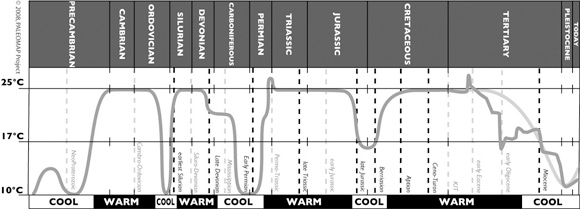
Image taken from serc.carleton.edu / On a 500 million year scale, we see the Great Ice Ages!
The UK, just had one of the snowiest winters for over thirty years. There was some covering on this HERE. A lot of people on the street start now explaining these events with the global warming. It has sunken in, that something is happening with our planet.
However cold and warm periods where always part of the overall shift beyond the seasons, on the scale of thousands of years. This time however the increase in temperature is different.
The seasonal build up and melting away of ice in the arctic and mountain regions is part of the seasonal phenomena. This way the ice works as a fresh water storage for the planet. If there is now more ice melting away than is produced during the colder month less fresh water is available during the hotter month.
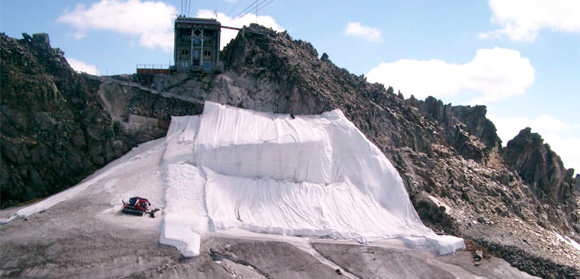
Image taken from Eiger International / IceProtector Optiforce in action, location unknown.
Several projects are now testing methods to keep the ice cool during the summer. In Switzerland special ice blankets are used to cover the ice and snow to protect it from the summer sun. However you can probably not attest them of saving the planet, but more their ski slopes, jumps and half pipes for the next season of winter tourists. Nevertheless the same technique has now been used in trials for larger scale test to tackle global warming phenomena. A produce of the sheet material is the Landolt Group based in central Switzerland.
This is how it works: “A lightweight dual-layer composite, its top layer consists of polyester to reflect ultraviolet light while the bottom, composed of polypropylene, is a polymer that is often used to block heat. Its purpose is to prevent a glacier’s top snow layer and permanent ice base from melting in the summer. At a cost of $12 million per square mile, the material has already proved successful in a small pilot in which its use on the Gurschen glacier resulted in 80% less melt than surrounding snow and ice two years in a row.” (as explained on threehugger)
It looks a bit funny, but has this poetic element to it that we were introduced to by Christo and Jeanne-Claude with their wrappings of natural and artificial features. At first when I saw the images I thought it is a joke or another Christo copying project, but it appears to be serious. Everyone seems to know about this - why hasn’t anyone told me this before?
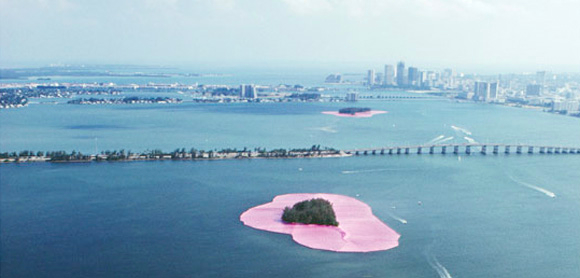
Image by Wolfgang Volz, taken from NYC.gov / Christo and Jeanne-Claude: Surrounded Islands, Biscayne Bay, Greater Miami, Florida, 1980-83
The blankets are now tested around the globe, from Europe to Aspen. Here a clip that introduces the snowtorium in Jackson WY.
Discovery Channel documents a project to use the ice blankets in Greenland to stop the ice melting away as a result of the global warming. This is for a change a real hands on solution. The climate summit in Denmark is only a few weeks in the past but the debate about the problem of global warming is already dried out. Would be nice to see more of these hands on proposals and less talking about who is responsible.
Picked up through mammoth.
It is not as if there are better seasons or worse, but strong character associations exist as part of the culture and for cultures worldwide according to the local seasonal conditions.
Image taken from serc.carleton.edu / On a 500 million year scale, we see the Great Ice Ages!

The UK, just had one of the snowiest winters for over thirty years. There was some covering on this HERE. A lot of people on the street start now explaining these events with the global warming. It has sunken in, that something is happening with our planet.
However cold and warm periods where always part of the overall shift beyond the seasons, on the scale of thousands of years. This time however the increase in temperature is different.
The seasonal build up and melting away of ice in the arctic and mountain regions is part of the seasonal phenomena. This way the ice works as a fresh water storage for the planet. If there is now more ice melting away than is produced during the colder month less fresh water is available during the hotter month.
Image taken from Eiger International / IceProtector Optiforce in action, location unknown.
Several projects are now testing methods to keep the ice cool during the summer. In Switzerland special ice blankets are used to cover the ice and snow to protect it from the summer sun. However you can probably not attest them of saving the planet, but more their ski slopes, jumps and half pipes for the next season of winter tourists. Nevertheless the same technique has now been used in trials for larger scale test to tackle global warming phenomena. A produce of the sheet material is the Landolt Group based in central Switzerland.
This is how it works: “A lightweight dual-layer composite, its top layer consists of polyester to reflect ultraviolet light while the bottom, composed of polypropylene, is a polymer that is often used to block heat. Its purpose is to prevent a glacier’s top snow layer and permanent ice base from melting in the summer. At a cost of $12 million per square mile, the material has already proved successful in a small pilot in which its use on the Gurschen glacier resulted in 80% less melt than surrounding snow and ice two years in a row.” (as explained on threehugger)
It looks a bit funny, but has this poetic element to it that we were introduced to by Christo and Jeanne-Claude with their wrappings of natural and artificial features. At first when I saw the images I thought it is a joke or another Christo copying project, but it appears to be serious. Everyone seems to know about this - why hasn’t anyone told me this before?
Image by Wolfgang Volz, taken from NYC.gov / Christo and Jeanne-Claude: Surrounded Islands, Biscayne Bay, Greater Miami, Florida, 1980-83
The blankets are now tested around the globe, from Europe to Aspen. Here a clip that introduces the snowtorium in Jackson WY.
Discovery Channel documents a project to use the ice blankets in Greenland to stop the ice melting away as a result of the global warming. This is for a change a real hands on solution. The climate summit in Denmark is only a few weeks in the past but the debate about the problem of global warming is already dried out. Would be nice to see more of these hands on proposals and less talking about who is responsible.
Picked up through mammoth.
Rabu, 06 Januari 2010
Every Year
Every year again the winter season comes round and brings the cold weather. Only eleven month back in February 2009 London was snowed in and it resulted in one of the biggest travel chaos in recent years. There was no bus service and little train service. Only very few people actually managed to get in to work and it made for a perfect monday out in the snow. You probably remember the posts on this blog HERE and HERE.
The snow is back and it really hit the whole of the UK. Forecasts warned about dramatic conditions already days back and unlike last time everyone jumped on it. Sales of winter goods soared. People around the country panic bought everything of the selves of supermarkets according to todays METRO with some goods there is a 1000 percent rise of demand, as for example with thermal underwear at ASDA.
However, the amount of snow in central London today is rather disappointing. The streets are basically free of snow, the public transport runs ok and I am at work. There are signs of disruption elsewhere. Outside London there is quite a lot of snow and commuters from outside do face difficulties to get into work and a lot will not be able to come in. This results in empty streets and little traffic. My bus journey was as smooth as never.

Image by single-blogs / not much snow on the crossroad at Euston Station and empty streets down Gower Street this morning.
Airports around London, like Luton and Gatwick are having problems and Gatwick closed temporarily over night. A lot of flights are being cancelled.
It is really for the UK not a routine event. Snow hasn’t really been part of the seasonal cycle to this extend, but occurring for the second time it might become a ‘feature’ of the winter month and the country has to get used to it?
It is still snowing now here in central London and around 5cm of fresh snow are expected over the course of today.
The snow is back and it really hit the whole of the UK. Forecasts warned about dramatic conditions already days back and unlike last time everyone jumped on it. Sales of winter goods soared. People around the country panic bought everything of the selves of supermarkets according to todays METRO with some goods there is a 1000 percent rise of demand, as for example with thermal underwear at ASDA.
However, the amount of snow in central London today is rather disappointing. The streets are basically free of snow, the public transport runs ok and I am at work. There are signs of disruption elsewhere. Outside London there is quite a lot of snow and commuters from outside do face difficulties to get into work and a lot will not be able to come in. This results in empty streets and little traffic. My bus journey was as smooth as never.
Image by single-blogs / not much snow on the crossroad at Euston Station and empty streets down Gower Street this morning.
Airports around London, like Luton and Gatwick are having problems and Gatwick closed temporarily over night. A lot of flights are being cancelled.
It is really for the UK not a routine event. Snow hasn’t really been part of the seasonal cycle to this extend, but occurring for the second time it might become a ‘feature’ of the winter month and the country has to get used to it?
It is still snowing now here in central London and around 5cm of fresh snow are expected over the course of today.
Rabu, 30 Desember 2009
24 Hours Palma de Mallorca
TimeLapse really makes sense to shorten a timespan and squeeze a lot of time into a short while. Well, everyone tried to do it all the time and multitasking is on e way of archiving something similar.
TimeLapse photography has something relaxing, partly because one can enjoy a few moments knowing you get only ‘the best of’. With this example you get the best of a popular holiday destination over one day in just 03:25, if this is no selling point.
TimeLapse photography has something relaxing, partly because one can enjoy a few moments knowing you get only ‘the best of’. With this example you get the best of a popular holiday destination over one day in just 03:25, if this is no selling point.
Palma de Mallorca's Bay, a 24 hour Timelapse from Franklin Tello on Vimeo.
Rabu, 11 November 2009
A Day in the Life of the City
An attempt to mimic the daylight in the city. The project is realised as an A-level art project by the student jamatkins. The sound scape is also quite nice, so turn your headphones up.
Senin, 02 November 2009
The Daily Cycle With a Small Chance of Change
Let’s start the week with a beautiful tale of routine. It is all going according to plan, back and forward, but wait there might be something different. I noticed this and that and felt quit different for it. We meet, we part, we ignore and still follow the pattern on time.
It is an animation directed by Sola Baptiste, inspired by Josef Albers' work.
It is an animation directed by Sola Baptiste, inspired by Josef Albers' work.
L'échange - The exchange from Baptiste Sola on Vimeo.
Langganan:
Postingan (Atom)