Tampilkan postingan dengan label art. Tampilkan semua postingan

Senin, 16 Mei 2011

4/10 Why Mediate Art? - Twitter Text Network

Milan based Mousse magazine is running a series with the title 'Ten Fundamental Questions of Curating'. The editor of the series, Jens Hoffmann explains: "it emerged from a desire to trace the coordinates of contemporary curatorial practice, to take stock of a profession that is constantly evolving. Through the contributions of ten curators, the ten essays in the project examine ten fundamental themes in curating. The booklets are structured as hypothetical chapters in a book that once completed, through the reflections of some of the leading figures in the contemporary scene, will try to offer an answer to the question of “what it means to be a curator today”

I was invited by the London based artist Marysia Lewandowska to collaborate on her contribution to the fourth edition.

Mousse 4/10 Why Mediate Art?
Image taken from Mousse / Page one of '4/10 Why Mediate Art?'.

The fourth instalment of “Ten Fundamental Questions of Curating” looks for an answer to the question “Why Mediate Art?”. The editor Jens Hoffmann invited Maria Lind to contribute who in turn proposed to work with Marysia Lewandowska as an artist curator collaboration. In her text Maria Lind examines the seeming paradoxes that revolve around art institutions: an overabundance of traditional educational activities, aimed at engaging an ever broader public; marketing departments and press offices that take on a strategic role; curators who have no real interest in making their project known outside the professional sphere. The Swedish curator explains the importance of weaving connections between works, curatorial projects and the public, for a new kind of artistic “mediation”. Marysia Lewandowska proposal extends the meaning of mediation in our networked culture by connecting the ‘followers’ of major contemporary art museum and public galleries and Maria Lind’s text through twitter.

Mousse 4/10 Why Mediate Art?
Image taken from Mousse / Page one of '4/10 Why Mediate Art?'. Click Image for the interactive version.

This is the time when art is mediated to its audience not only through lectures, seminars, artists’ talks, guided tours and publications but when mediation intervenes as a pulsating stream of immediacy, mixing the promotional intentions of the institution with the visitors’ desires of sharing their observations and responses. The banal is closely entangled with the political, the randomness is attached to a system as announced by the ubiquitous banner: Twitter is a rich source of instantly updated information. It's easy to stay updated on an incredibly wide variety of topics. By utilising the social networking platforms such as Facebook, YouTube and Twitter that emerged over the past few years, the communication between the art institutions and their audiences has grown into a real time stream of information snippets.

Interactive version created by single-blogs using the GMap Image Cutter / Twitter Education. Tweets collected using 140kit, to visualise the network Gephi was used. Click HERE for the full screen version.

What appears on the visuals are graphs mapping tweets sent by three major art institutions, Tate in London, MOMA in New York and Moderna Museet in Stockholm to communicate and mediate their activities as they are enmeshed together with Maria Lind’s text. The two text streams have been aggregated as a word chain, where each word is connected with a link to the following word in the sentence. Each word is represented only once as a node in the chain, but in many cases with multiple connections, edges, to the following words. The resulting visualisation is of a network based on the structure of the words in use. The two different sources are distinguished where red lines represent the links between the words in the tweets sent by the art institutions, while the black lines show the flow of the essay written by Maria Lind. The tweets cover the period between 2009-09-16,15:18 and 2010-11-29 16:03.

Mousse 4/10 Why Mediate Art?
Image taken from Mousse / Page one of '4/10 Why Mediate Art?'. Tweets collected using 140kit, to visualise the network Gephi was used. Click Image for the interactive version.

For artist Marysia Lewandowska the mapping of this flow expresses a desire and interest in distributive networks without restriction; it is the desire of being in touch and engaged, of organising one’s thoughts and sharing them instantly. The knowledge ecologies of a wider world intersect in unexpected ways and point to the role mediation plays in shaping our current social and political life.

Publication - Mousse, Editor - Jens Hoffmann, Text – Maria Lind, Art – Marysia Lewandowska, published 2011.

Ten Fundamental Questions of Curating, edited by Jens Hoffmann and published by Mousse in collaboration with the Fiorucci Art Trust, is distributed with the international edition of Mousse and with subscription copies.

Interactive version created by single-blogs using the GMap Image Cutter / Twitter Education. Tweets collected using 140kit, to visualise the network Gephi was used. Click HERE for the full screen version.

Selasa, 19 April 2011

Datamatics Ver.2.0 - Data Viz Black and White

As part of the Spill Festival of Performance 2011 at the Barbican, Ryoji Ikeda played a set. It was another installment of his Datamatics Series started back in 2006. The new Datamatics [ver.2.0] series has evolved quite a bit from the first version already played at events around the world including Sonar, Barcelona (2006); Mutek, Mexico City (2007); Centre Pompidou, Paris (2007); RomaEuropa, Rome (2008); Itaú Cultural, Sao Paulo (2009) and Second Nature, Aix-en-Provence (2010) to name a few.

The soundscape is an artwork based on purely mathematical parameters transforming electronic data into sound and visualisations. Ikeda describes it: "Using pure data as a source for sound and visuals, datamatics combines abstract and mimetic presentations of matter, time and space in a powerful and breathtakingly accomplished work."

data.tron
Image taken from ryojiikeda.com / data.tron [8K enhanced version] audiovisual installation - 2008-09. Materials - 8 DLP projectors, computers, 9.2ch sound system. Dimensions - W16 x H9 x D9m. Date / Place JAN 1, 2009 - DEC 31, 2010 Deep Space venue, Ars Electronica Center, Linz, AT. Credits - concept, composition: Ryoji ikeda, computer graphics, programming: Tomonaga Tokuyama commissioned by Ars Electronica, 2008-09.

Breathtakingly it definitely is. The installation has you on the edge of the seat from very early on. The level of abstraction, the volume and the frequency of the flickering on screen mount to a experience very close the the limitation of the actually perceivable. After onl ten minutes the first people leave.

This work is clearly set in a wider context of sound art and electronic music. A few references to spring to mind immediately are John Cage as the very early highlight, Daft Punk with the Tron collaboration. Then there are also some more recent web project where data visualisation has turned into very playful results as for example with the Subway Conductor by Alexander Chen.

Interesting are Ikeda's use of geometrical elements for the visualisation. The main elements obviously are lines, both as geometrical lines but also as animated data lines. The Datamatics 2.0 performance then also starts with a linear setup, first vertical scrolling, then horizontal scrolling. The next element is the data point. Here again in many different variations, including as a node connected to other data points in 2D and 3D. Additional elements are planes and then effects such as spinning, copy and fast forward. With this basic setup the set reminds also of the short story 'Flatland' (if you haven't read it pdf is available HERE).

data.tron
Image taken from artshool.cfa / John Cage Liberation of sound.

However the visuals are not limited to the geometric elements. From early on, also with rather simple elements the screen is only showing a flat representation. The visuals are always rendering, an abstract, three dimensional scape. The visuals have clear references, of ist and arrays all the way to interstellar arrangements, the big bang and the glow of a sun with the removing of the geometries keeping only the texts. The audio on the other hand also has its elements that it evokes, from highway traveling to train journeys or rain you'll find it all in the sounds scapes.

Of course on is curious what sort of data sets Ikeda is using for the performance. Is it a sort of stream like a twitter feed, or is it a more static field like property data, but maybe it is some medical data on DNA sequencing or the time table of the Moscow subway?

At first the performance at the Barbican feat like a film screening, only at the very end as Ikeda rushed from the back onto the stage during the applause it became clear he was actually present and involved in the performance. However how much of it was live and 'interactive' remained unclear.

Nevertheless the audience was engaged from early on. Each time the performance released the audience from its strong grip of audio visual bombardment sighs of relieve and cheers spread the ranks. This almost physical link through the intensity of the experience was challenging, but at the same time created a very intimate connection.

A trailer of Ikeda's Dramatic [er.2.0] set.

Minggu, 20 Februari 2011

Collective Memory - Photo Collage

Taking pictures is the main activity for tourists. They are constantly snapping away, trying to capture the extend of their explorations, banning experience onto the sensor. A certain desire drives them, the eager to document what has happened in order to proof that it did.

It is like almost taking a piece of it home. This idea of possession or conquering is still part of the human nature as hunter and collector and going on holiday is only successful once one can see the perfect view on the tiny little LCD screen of the camera over and over again. Like a box ticked.

Vionnet Moscow
Image taken from mymodernmet / St. Basil's basilica on the Red Square in Moscow

The Swiss artist Corinne Vionnet has built here work 'Photo Opportunity' around this topics. From online sharing sites she sources her material of hundreds of similar snapshots of landmarks, in German 'Sehenswuerdigkeit' (literally translated 'worthy to see'), and overlays them as transparent images. The results are slightly blurred, but recognisable images of the landmarks of the top snap shot locations around the world.

Regarding the sourcing of images Vionett explains "This work is intrinsically linked to the people who took these pictures. The collaboration is obvious, but it is without their knowledge. These pictures are on the Internet, to be seen by any eventual visitors. I am just one of those visitors. It is the sheer quantity of these almost identical pictures that gave me the idea of superimposing them. I do not think I would have had the idea if I had made all these pictures of the same places myself. Anyway, the work would loose its meaning."

Vionnet London Parliament
Image taken from photolucida / THe Parliament in London

The images evoke a sense of a collective memory. They quite literally illustrate this idea of hundreds of people sharing he same experience. In this case it is having see the same thing, or more precise having taking almost the ame picture. What they have seen is not quite clear.

Interesting is that each image shows the same subject, largely they are visually the same images. However the collective memory is defined by Maurice Halbwach as: "While the collective memory endures and draws strength from its base in a coherent body of people, it is individuals as group members who remember" (Maurice Halbwachs, Collective Memory, p.48) His conception of collective memory as a very confined and group specific construction is very clear and he was one of the first to promote this idea of connected and very local collective memories.

Vionnet Beijing Forbidden City
Image taken from photolucida / The Forbidden City in Beijing China. Here Vionnet has focus on the Mao portrait to adjust the different images overlaid.

A similar approach is taken by the German artist xxxx. He also uses online photo sharing platforms such as flickr to manipulate images and provoke memories of personal experiences.
He explains: "The installation consists of two projections, the perception and the memory layer. Both shell be explained in what follows.
The perception layer represents the sensory memory before any priorities have been chosen. It receives the newest images from flickr (flickr.com) which get distorted, mixed and blended to persuade some sort of sensory noise."

20
Image taken from Matthias Dörfelt / Screenshot of my installation "Selective Memory Theatre" which is my bachelor thesis at art school.

Selasa, 15 Februari 2011

Sound Based Research - Fieldwork

Sound is part of the everyday experience landscape as much as the visual, however dramatically less present. The dimensions and the extensions of sound scapes were earlier discussed in the MyTime interview with Salomé Voegelin.

One of the major topics in this discussion was the relationship between sound and space or the construction of an soundTimeSpace a Voegelin called it.

Check In / Check Out
Image by Andriko Lozowy taken from merlepachett / View of a tailings pond and Syncrude Oil Sand Mine in the distance.

In some new research work, Merle Pachett investigates sound landscapes. She has be working recently in Canada and her project im by mapping the acoustic ecologies of the Athebasca Oil Sands to develop on the work of the ground-breaking 1970’s project Soundscapes of Canada whose objective was to capture disappearing sounds in response to over noise pollution.


Sound by Merlet Patchett

In her most recent presentation of the collected raw material she collaborates with a photographer, Andriko Lozowy, from the University of Alberta. The two media appear to work rather well together and do not simply merge into one as if it were video recordings. The tension that builds up between the different media is really the interesting bit in this documentation.

It is not as if sound was too boring to listen to just like that, but with the photographs a certain dialect emerges between how it looked at this time and how it sounds in this moment.

It seems surprising how the aspects of time play a very different role in both these two medias. We are trained and have acostomised to read photographs as a document of the past. Certain aspects of the image can be read as to guess the approximate time distance. With sound however, this seems less of an immediate reaction. This data is much more in the present, there is not this reflex as to put it as something of the past.


Sound by Merlet Patchett

Check In / Check Out
Image by Andriko Lozowy taken from merlepachett / Fort McKay Industrial Park.

Rabu, 09 Februari 2011

Sorting Shapes and Cleaning up Cities

What would the world look like if we get everything sorted? Things would be tucked away neatly, places are clean, papers sorted and regulations clear. Maybe.

Sorting and cleaning, polishing and updating, pushing and flushing are frequent terms used in design and research and as part of the discussion definitely have a relevance. They convey a certain change and proposition together with implied 'to the better'.

Armelle Caron
Image taken from Armelle Caron / Paris as it is and sorted.

As usual with terms they can be overused, for things they don't apply or to describe something that is not this way or doesn't even exist. Even more so, they can be over stretched and filled with an missionary believe and practice and followism. This is definitely the case when people start to believe in one of the terms as being the only one, the world saving solution.

Academia is pruned to be a place for sorting and clearing, but on the other hand is also a very messy place. But hey invention and creativity are different beasts altogether. Anyway, it is probably the exchange and the collaboration that prevents ideas and concept to overflow and draining down one of these few juicy terms.

Armelle Caron
Image taken from Armelle Caron / Tamarac as it is and sorted.

Mapping is one of the very visual disciplines that is fundamentally about ordering and sorting. This is built on a intelectual concept of reference, singularity and ultimately truth. A very helpful strategy actually, with a lot of benefits as an abstract representation, simplified to clarify. Nevertheless, the combination of the terms is lethal in terms of reprojection. The things do no longer add up if the abstraction is reversed as a revitalised self. A map is a map, is a map, is a map.

For not bringing them back we can as well sort them pieces. In any order, as you please, but let them be abstractions.

Armelle Caron
Image taken from Armelle Caron / MontPellier as it is and sorted.

Armell Caron has produced these wonderfully sorted pieces of sections or urban plans, sorted into order, any order but the previous one. Nights working on the computer tracing and then moving piece by piece with the curser in Illustrator until neatly sorted in rows. Seems like a very meditative work, at least the power of them illustrations suggests this. Works developed 2005 / 2008.

Via PYTR 75, more details on Armell's blog, on socks-studio, urbain-trop-urabain, the map room or on deconcrete.

Armelle Caron
Image taken from urbain-trop-urabain / City blocks made from wood as a giant puzzle. Probably impossible to sort it exactly in the original way, but there are plenty of variations to mess about.

Selasa, 08 Februari 2011

Street View Indoors - Google Art Projet Brings Museums and Artworks Online

Google Street view is now continuing inside, at least for some of the words most important museums. Using the same technology Google has started the Google Art Project, making museums virtually accessible. Together with the indoor navigation a selection of paintings can also be seen and navigated in a Google Maps style in great detail. You can get up very close to Chris Ofilli's 'No Woman No Cry' at the Tate Britain. Close enough to see the individual dots of paint. In this case you can even switch to night view mode to see the fluorescent second layer of the painting. This of course applies also for all the other paintings marked with a pus sign, were you can study the details of Van Gogh's brush stroke for example.

GartProject_03
Image taken from the Google Art Project / Chris Ofilli's No Woman No Cry at the Tate Britain in London, United Kingdom.

Earlier, back in 2008 the Kremer Collection was one of the first to offer such a detailed look at paintings using the Google Maps style navigation and zoom function. The software used back then was the ImgeCutter software developed at CASA.

There is currently quite a lot of development going on with these digital visualisation and visiing technologies. From video street view to panoramic street view with street slides of bing maps, featured last week on digital urban.

GartProject_04
Image taken from the Google Art Project / Detail of Chris Ofilli's No Woman No Cry at the Tate Britain in London, United Kingdom. See the night view HERE.

After the Street View Project and earlier the Slope View for the Winter Games in Vancouver this is now a further step applying the technology in large public buildings.
It does require a bit of patience and an effort for not losing the orientation, since the museums network of possible routes is a lot more complicated than the roads. This is mainly down to distance and size. almost wich each click new route choices apply, this will keep you on your toes. In comparison the street view is relaxed with sometimes many clicks between crossroads.

However, the new project lets you browse 385 rooms in 17 galleries, and see more than 1,000 works by 486 artists. This includes galeries such as the National Gallery in London, the Tate Britain, the Uffizi Gallery in Florence or the State Hermitage Museum in St Petersburg.

GartProject_02
Image taken from the Google Art Project / A visit to the Palace of Versailles, France on the Google Art Project.

Google seems very interested in getting many different aspects of 'knowledge' represented through their technologies and after the Book Project this is now the art project. Of course the paintings remain property of their owners and remain copyright projected but are virtually accessible through this Google Service.

These copyright issues seem still very constraining. Some of the museums have surprisingly little rooms accesible on the database so far. It is unclear whether this project will extend and in what time frame. If you peak through doorways into rooms that are not accessible on this virtual tour the buildings are blurred as known from the Street View. This looks rather disturbing, probably more so than in the street scenes.


Ultimately notable is the change in design stile. It is a great relief to see that Google has adopted different style for this project and not using the comic, round edge, many colour approach that has become iconic for their brand. It would have been ridiculous to show these works in such a context. The only thing they coud not get to follow this new style is the page icon displayed in the browser tab.

On the navigation side, Google has decided to drop the view lines used in Street view. For this indoor version the user only has arrows to click on. There are usually is or eight arrows used for one point to allow for more detailed navigation. However, it is still difficult to just move slightly to one side and look beyond this annoying pillar, as for example in the State Hermitage main gallery. In general the navigation is much more free than experienced before and also works by just clicking on a doorway to get into the next room. The session will also remember the previous location in each museum. If you decide to look at some other paintings you can always jump back were you have left off, quite helpful.

Google has also added additional navigation features such as foor plans. As well as contextual information to the museum and the art work in a side frame. It is also possible to create a personal art collection by adding paintings to the collection. And Google has also embedded a sort of a social tool, where people can start a discussion about paintings by leaving comment.

However, with the navigation and the representation there is a very big remaining question regarding the architecture. All the museums are set in a very grand building and the experience of space, sequence, material and light , to name a few is in most cases very grand and worth the visit in itself. This is not the case in street view. On the contrary Google has managed to kill any such experience and completely flatten it out, architecture is dead.

Possible though, it would require rather little to take this in to account and the contextual setting of the individual art works could be part of the experience. On of these options would be to introduce a proper starting point or entrance to each museum. Currently the virtual visitor is simply dumped in one of the rooms in front of a painting at selecting the museum. Since many of the rooms at first glance look very similar it is very difficult to orientate or even know which museum one is visiting. If it is as in the case of the MoMa, where the starting point is in the entrance hall one is lost all together. The introduction of a stronger spatial narrative would definitely make a difference.

The quality of the images is possibly another issue. The different museum or rooms in the museums are not all being translated well into the digital format. Some seem to fit better than other. Especially the lighting quality seems to be very tricky to capture on camera. Appears the MoMa in New York very poor quality is on the other hand the Palace of Versailles is a lot more lively. Generally it can be said that the museums using colour tains on their walls come across a lot better than the white boxes. In a side note, this might change architecture trends if this technology becomes more trendy.

GartProject_01
Image taken from the Google Art Project / A visit to the Gemaeldegalerie in Berlin, Germany on the Google Art Project. The blue colour makes for a better quality image than most of the white rooms used in the other museums.

In terms of art and culture communication it will be very interesting to see how this influences the way the institutions are communicating about their works and collection. Potentially one can think of many applications including works discussions and art education. We will see how this develops.

Of course it would be great if this technology could move away form this simple panning style of navigation towards a more spatial representation of navigation. Also the respect for the architecture or een more important the spatial and sequential quality of the building would greatly enhance the experience. But for now we have to live with this, which good for a quick ok around the galeries and see some exciting art work one would maybe never or not for a long time see in its context.

Rabu, 19 Januari 2011

Book - Literature, Architecture, Landscape - one Project

No project is like the other, even if you run projects around the globe ranging in scale from big to large. Steven Holl currently is one of the very busy architects working on some large scale building projects in different countries from America, France to China.
The work grows and develops dramatically and already since his book Urbanisms was published last year a whole portfolio of projects can be added.

Hamsun Centre by Holl
Image taken from archicentral / Sketch by Steven Holl for the Knut Hamsun Centre in Norway.

This one here however is not one of them, this project is different and it has its own book. It is not about Steven Holl or his architecture. It is about something more, about a very successful synthesis for which architecture only plays a part.

Lars Mueller Publishers have published a new book 'Hamsun, Holl, Hamarøy 'on the Hamsun Centre, a museum or a cultural centre for the work of the important Norwegian writer Knut Hamsun, who won the Nobel Price in 1920 for his literature work "for his monumental work, Growth of the Soil".

Hamsun Centre by Holl
Image taken from bustler / The Knut Hamsun Center, located in Hamarøy, Norway and designed by Steven Holl Architects, opened to the public on August 4, 2009.

The publications brings together the two characters Hamsun, Holl and adds the great landscape of Nordland. It is not a project that is calling for attention and screams, this is a very pure piece of work, very focused and dedicated.

Holl was contacted back in 1994 to consider working on this project and over fourteen years later the building was opened in 2009. It seems like a real ove story, its not the typical job and the publication emphasises this personal aspect to a great extend, witch makes it a great read.

Hamsun's most famous text 'Hunger' plays a very important role in the building Holl proposed and as Juhani Pallasmaa in the essay puts it: "past the stone foundations of the former vicarage, we suddenly arrive at the tower, which seems to be tossing and turning in search of vertical posture. The upright image of the building with its window -eyes and ochre hair around its top suggested a human figure."

The landscape as mentioned, plays an important role too and features in each text contribution as either the context, but very often as the introduction, how the building is approaches is very central. Further more the landscape of course plays the dominating role in the sketches and photographs documenting the project. Its a journey, in the many meanings of the word, is the central theme. The fact that the site is above the Arctic Circle makes it just this bit more romantic.

Hamsun Centre by Holl
Image taken from Abitare / THe tower with one of the balconies and some of the context landscape.

The dedication goes through the project into the book. This publication will be your little treasure and you'll find a special place for it on the shelf.


Langdalen, E.F. et al., 2010. Hamsun, Holl, Hamarøy, Baden: Lars Müller Publishers.

Kamis, 13 Januari 2011

Postal Tracking - Where the Mail Goes

Sending letters through the post has something very romantic to it, but thats probably only because it has long been overtaken by instant messaging and tweeting. However, the mailing systems are big business and it is not that people send les stuff through the post.

Anything goes, just as Willie Reginald Bray pioneered, as documented in the recently published Princeton publication 'The Englishman Who Posted Himself and Other Curious Objects', parcel are sent everywhere.

How are these boxes over boxes actually shipped, how does it look and feel inside the sorting wear houses, to were did the van deliver before it stopped at my house? Tracing the journey of a parcel could be fascinating. Where Bray tested what can be sent, pioneers today what to find out how it is been sent.

The London based artist Time Knowles has investigated this in his ongoing series 'Postal Works' and is to showcase his latest postal tracking art work today. Keep posted for the link to the movie that will be released later in the day here!

http://www.e3-hs9.com/

Mk3
Image by Tim Knowles / 'Spy Box' A new postal work with the box, buggy and bearings made in perspex, a pen situated in the centre of the buggy traces out it's movements within the box. 2006 - Perspex, cardboard, pen, ink on paper

Knowles started however with his investigation a lot earlier. Very fascinating are his initial movement tracking projects. In the early days the packet contained a blank paper and a pen on wheels to record the movement of the box as it is being shipped through the postal system.

From these analogue projects Knowles moved on to GPS tracking and then also video and sound recording from inside the box as it is on its way from sender to receiver. Of course there where noumerous problems on the 'Spy Box's' way. This included a phone call from the FedEx Head of Security, as they detected the live electronic equipment in the box at the airport.

SpyBox
Image by Tim Knowles / 'Spy Box' A digital camera inside a parcel looks out through a small hole and captures images of its journey through the postal system. The Spy Box was sent from my studio to the gallery taking an image every 10 seconds recording a total of 6994 images these were then edited together to create an animated slideshow. E3 to WC1E - 2006 - Card, aluminium, digital camera, timing circuit, wiring & 6 min DVD loop.

For example "the parcel was stopped by FedEx,” Knowles said. “My phone number was on the box, so I ended up being on the phone to FedEx’s head of security for about 45 minutes explaining that it was an artwork, telling him just to open it up and that there was a switch that could turn it off.” Quite understandably FedEx’s security services said ‘There’s no way we’re opening it’ having X-rayed it and found live electrical equipment inside. They put the package into another card-board parcel and send it back to Knowles, leaving him with a lot of pictures of the inside of a box."

For the latest work Knowles teamed up with Roya Mail. With the recent bombs in FesEx parcels the issu of electronics in the mail was hot and risky. The latest work to be presented today remains therefor in the UK and is a parcel sent from London E3 5QZ, near Victoria Park, to HS9 5XW, Isle of Barra.

PICT129-ScanmnaAnimation
Image by Tim Knowles / 'Pot Box'

On the 902 mile journey the mounted camera took 20'000 pictures and recorded a continuous sound stream. As the Independent journalist Matilda Battersby notes about the work: "One of the lovely things about watching the painstakingly compiled video and audio compilation of the parcel’s journey is the many changing accents and commentary from the workers as it makes its way".

The work is presented to day between 18h30-20h30 at Contemporary Art Society, 11-15 Emerald Street, London WC1N 3QL. A limited book edition is available with the title 'Post Box E3 5QZ – HS9 5XW'.

PICT073-0848k
Image by Tim Knowles / 'Pot Box'

----
U P D A T E 2011-01-14

The website is online at http://www.e3-hs9.com/ and it shows the the video recorded on the parcels journey together with the audio recordings and a map. The parcel was GPS tracked on its journey.
Head over to the website to check out the details.

Kamis, 23 Desember 2010

Twitter Art Network - the Big Players

Twitter as an information service has developed rapidly since 2009. Most institutions have by now adopted a twitter account to distribute news and stay in touch with an audience.
Especially in the art world museums and galleries started using the social networking platform, creating important nodes in the twitter univers.

Some art institutions managed to attract a large fellowship with the @Tate for example having about 216,308 followers or the @MoMa with 388,670 followers.

artInstitutions
Graph by single-blogs / Major art museums have adopted twitter as a networking and news channel tool. This art institutions twitter social network is constructed from @ tweets and RT tweets as a directed network graph.
Data collected using 140kit and visualised using gephi.


Of course now of interest is how these nodes link in to the wider twitter network and also how they link to each other. There are of course a number of different interests colliding and this reflects the stiff competition to some extend.

From the most recent 2000 twitter messages by each institution a social network graph was generated to visualise how some of the top museums are connected through activity in tweet terms. The graph represents how the institutions interact with other users and how this connects them into an entangled social network.

artInstitutions_zoom01
Graph by single-blogs / Zoom in on details around the New Yorker museums MoMa, New Museum, Guggenheim and the SFMoMa,

The nodes represent twitter users and the edges, connection lines, are established through @ tweets, a public direct message at some other user(s). The second indicator for established connection are the RT, the retweeting of messages by others.

Interesting to see is how the institutions have rather few direct links, but share quite a bit of intermediate twitter users. Especially between the american institutions there are quite some established connections, but also links across the atlantic are establish. Explore the graph in details below using the Google Maps style navigation.

Art Institutions Social Network

Graph by single-blogs using the GMap Image Cutter / Art Institutions Social Network - Use the Google Maps style zoom function in the top left corner to zoom into the map and explore it in detail. Click HERE for a full screen view.

You can check out the institutions involved on twitter for detailed info on the tweets.
@ZKM, @newmuseum, @tate, @MoMa, @sfmoma, @MOCAlosangeles, @vanabbemuseum, @ModernaMuseet, @mori_art_museum, @centrepompidou, @metmuseum, @guggenheim, @maspmuseu, @V_and_A, @NationalGallery, @npglondon, @_TheWhitechapel

Minggu, 10 Oktober 2010

Periplastic

----
A guest post by David Bruce from davidbrucestudios.com, contributing to the second Ecological Urbanism discussion hosted by Annick Labeca, Taneha Bacchin, DPR-Barcelona and single-blogs.
----


Space is the periplastic medium of the city; forming as necessary to meet the needs of an ever-changing society. Ideas developed by Lefebvre, Gottdiener, Deluze and Bachelard are among those that shape the foundation of contemporary architectural and urban practice. At the height of the urban experiment lie far reaching goals articulated through computational geometries applied to the architectural form. Yet in the wake of these new and engaging visions for the future we remain deeply rooted in existing physical infrastructures and traditional means of engagement. So what does it mean to reconfigure the space of the city in relation to ecological urbanism? And how do everyday citizens, including artists, designers and other professionals, work together to explore new ideas and affect change as we develop the ecological ethos necessary to generate the “new ethic and aesthetic of the urban”?

These are broad questions that require a multidisciplinary approach in order to address complex social, cultural, political and environmental aspects of space in the city. As an artist with an ear to the ground of this discourse I am drawn to spaces where people interact to creatively address these issues. Contemporary artists often work to alter existing infrastructures and create new sites where everyday people engage new ways to view the city. These spaces contribute to the diversification of the everyday experience and in doing so increase the richness of urban environment.

John Roloff’s conceptual studies of piers 15-17 in San Francisco, CA offer a brief insight on this subject. Roloff was trained as a geologist in the 60’s. Over the past 50 years he has employed his knowledge of environmental systems to create art. His work examines relations between man and nature through an array of projects situated somewhere between art, research science and architecture. He specifically engages the concept “synthetic ecology” while integrating a systemic awareness of ecological processes with the built environment. For Roloff, “Synthetic ecology morphs into trans-scientific forms of empathetic aesthetics, meta-ecology, and themes of alignment, indivisibility and equilibrium between living and non-living systems.” As a point of entry into the spatial inquires of ecological urbanism this idea captures something beyond the typical discourse on sustainability to bridge the gap between aesthetics and pragmatism.

I became specifically interested in Roloff’s studies for this site due to a strategic inversion of the pier assembly. The proposed inversion is a didactic sculptural maneuver. It exposes the hidden dimension of the pier’s structural elements by reassembling them upside down on top of the pier along with representations of the marine and terrestrial strata through which the pylons pass. This upturning of the spatial and structural character of the pier creates a site of exposure. The mundane aspect of passage over, onto and off of a pedestrian element of the bay’s infrastructure is suspended by an intrusion of the unusual; an infrastructural presence that punctuates a moment of aesthetic reflection.

johnRolloff_pier15-17
Image by John Roloff / Future Exploratorium Site: Pier 15/17, San Francisco, CA

Roloff’s inversion offers a window to the larger questions approached through this series. As concepts of ecology, systems theory and cybernetics transform our perception of the city how do everyday citizens access the infrastructural counterparts of these concepts? If methods of production are subject to mystification, veiling and erasure then how can we expect everyday “users” to develop an awareness of these mechanisms, participate in a dialogue about them and in turn cultivate the ethos necessary for real transformation? In the case of these questions Roloff’s maneuver provides a starting point and a valuable strategy for an exposition of urban complexity. Were there strategically excavated sections of a streetscape exposing below ground systems and the layering of asphalt, concrete, and rubble used to establish a foundation, or meticulously carved away cross sections through the city, these ruptures in the urban matrix could give rise to a new aesthetic appreciation for the complexity of our daily environment; in turn creating new public sites where ideas surrounding urbanism become prevalent topics of discussion. Gordon Matta-Clark was a pioneer of this aesthetic procedure. His “building cut” installations of the 1970’s garnered attention throughout the art, design and architectural community worldwide. What I imagine could be conceptualized as an extension of his procedures into a far more dense amalgamation of civic infrastructure to produce an overwhelming sense of exposure capable of engaging the everyday citizen in new ways of looking at the city.

gordon_matta-clark
Image by Gordon Matta-Clark, “Building Cuts” 1970’s

Strategies like Roloff’s inversion or Clark’s building cuts can be designed to function as public sites in which the evolution of building systems, materials and technologies can be highlighted and directly experienced. They are sculptural marks that create windows into the hidden dimension of urban ecosystems as well as primary reconfigurations of the urban matrix that open the system to new possibilities; Roloff’s seeks to inform while Clark’s seeks to disrupt. Both strategies can be of use to the artist, architect and planner aligned with sustainable practices because ecological urbanism must simultaneously seek to maintain some degree of coherence within the established social, political and economic systems, while at the same time challenge these structures in an effort to cultivate a new praxis.

While planning communities remain focused on practical transformations of the cities infrastructure with respect to ecological urbanism, today’s cities must have affordances for spatial experimentation like those presented above. Sites of adaptation, experimentation and exhibition are the materiel analogues of open source programming. Within the existing fabric of the city these sites are often relegated to interstitial spaces between commonly authorized uses. They go unnoticed until an unforeseen artist or subculture engages the site; marking or deploying an unplanned, unusual or unwanted incursion. Spaces like those mentioned above become socially, culturally and politically charged through the action of artists and designers who take an alternative approach to accepted modes of practice. But the marginal status of these spaces and practices is changing. Social entrepreneurs are cultivating, absorbing and transforming them into viable models for generating creative capital.

Scott Burnham is one of those entrepreneurs. Burnham charts innovation at the edge of urban culture. In 2008 he collaborated with Droog Design to curate Urban Play; a public exhibition of “3D Graffiti” placed in the streets and public spaces of Amsterdam. Burnham assembled a team of artists, architects and designers to collaborate in the creation of 12 innovative projects aimed at “Reversing the traditional approach to urban design, in which objects and areas are created explicitly to discourage public interaction and intervention, this collection of objects were created to encourage interaction and physical engagement by the public.”

urbanPlay
Image by Urban Play / 2008

Burnham’s approach is one of many aimed at advancing issues of urbanism and public engagement. In the past many of these works would have fallen into the category of gorilla art (and still would be were it not for their assimilation under the umbrella of a design festival). But as these incursions become more prevalent they gain momentum and take on a more mature role in mainstream culture. As the professional community continues to support a multidisciplinary approach to problem solving civic spaces will adapt and artists will continue to transform existing infrastructures into sites where diverse publics can experiment with new technologies, experience the new ways of imaging the city and generate new social relations that alter the urban lexicon.


----

David Bruce from davidbrucestudios.com is an artist living and working in Philadelphia, Pennsylvania while perusing a Masters Degree of Fine Art at Temple University’s Tyler School of Art. His current work revolves around changes in environmental perception and behavior in relation to urbanism, network culture and technology. He received his bachelor’s degree in Urban Planning with a minor in ecology from East Carolina University in 2003. Focusing curatorial interests on the intersection of art, architecture, and urbanism he plays an active role as gallery manager for Temple University’s Exhibition and Public Programs department.

Jumat, 08 Oktober 2010

Art & Urbanism

----
A guest post by Pieter Vandendorpe from PYTR75, contributing to the second Ecological Urbanism discussion hosted by Annick Labeca, Taneha Bacchin, DPR-Barcelona and single-blogs.
----


image 0
Image by Xing Danwen / Urban Fiction, image 0 (detail) (2004)

----
Click the image and read more on Urban Lab Global City

Senin, 04 Oktober 2010

Street View Art - A Street With a View

What's this oversized feather and headless rooster in Google Street View doing on the free plot next to the road? It is actually a massive 'poulet' and it didn't get there by chance, did it?
As it stands Google Street View gets actually quite boring after the first rush of voyeurism has sort of worn out a bit, but there is something very exciting about this.

SWAV_chicken
Image taken from Google Street View / The chicken at Arch Street/Sampsonia Way crossing.

After these only two years since Google started rolling out the Street View 'service' it ha become so everyday that there is little excitement attached to it anymore. It is handy though at times.
I was reminded of the Street View 'service' a couple of days ago through the 'The Wilderness Downtown' project which reinterprets 'We Used To Wait' by Arcade Fire as a music video which was run through Google Chrome as an HTML 5 promotion. It is great though and producer Chris Milk makes good use of Street View. However, surprisingly few projects have really picked up on the service and used it as raw data or working tool. It has in certain field rather produced a sort of repulsion and anti Google projects were developed as in F.A.T.

However, in the early days, and this was back in 2008, a more subtile project was actually integrated directly with the raw data, the images recorded by the official Google Street Car. "On May 3rd 2008, artists Robin Hewlett and Ben Kinsley invited the Google Inc. Street View team and residents of Pittsburgh’s Northside to collaborate on a series of tableaux along Sampsonia Way." (StreetWithAView)

The resulting images still form part of the imagery accessible through the Google Map platform via Street View. Hewlett and Kinsley staged a series of street scenes around Sampsonia Way in Pittsburg including a Mad Scientists Lab or a Garage Band which was recorded by the passing Google Street View car.

The artists have arranged for a great variety of different activities or scenes across the relatively short length of the road. A complete list of scenes can be found HERE.

SWAV_science
Image taken from Google Street View / The mad scientists lab.

In the making of clip, below, the artists explain the idea. Note how they struggle to explain what Street View actually is: a sort of Quick Time VR for all the road in the city. By now this has changed and Street View as in how-it-works-what-it-is has become a brand and is a term at the same time. Much as Google is for finding something on the internet.


As such the project should actually have had more of an impact and could even in terms of city marketing have a relevance. The 'location factor' has in the past couple of years had a dramatic impact on location and place and the project beautifully illustrates how it could be performed on a rathe rough and globally accessible level.

More so, than opposing and attempting to legally argue about privacy, vintage point and the hight of a fence, communities could in a collaborative effort put together a live show of the neighbourhood and stage their local area as a place as unique and divers as the people who live in it. So get our friends together check the Google Street View car schedule and make up your story of the Neighbourhood. Now thats a show.

SWAV_parade
Image taken from Google Street View / The carnival scene

Kamis, 30 September 2010

MyTime Interview - Salomé Voegelin on SoundTimeSpace

The urban and the sound are very much one and the same. Noises and tweets, squeaks and bangs, whispers and rattle are constantly present and play an important part in the shaping of the environment. consciously or unconsciously we are attracted or repulsed by certain sounds in specific configurations. But how is it interlinked with time and space, how does it tie in with time and certainly space, the much talked focus in the urban discussion.

In this interview we want to discuss these questions with Salomé Voegelin, an artist and writer who is concerned with the practice and philosophy of sound. Her work has been shown in the UK and Mainland Europe. Most recently her work "Barry Echo" has been included in Playing with Words, the Spoken Word in Artistic Practice, Cathy Lane ed., UK, CRiSAP and RGAP, Cornerhouse Publication, 2008. In 2007 she was commissioned to produce an urban pod-cast for RADAR in Loughborough, UK, and to realise, in collaboration with artist and writer David Mollin, a site-specific work for the Bregenz Kunstverein, Magazin 4, Austria. She is the curator of Clickanywhere, an online sound exhibition featuring sound work that focuses on the voice, http://clickanywhere.crisap.org/. Her published writing includes 'Sonic Memory Material as "Pathetic Trigger" ' in Organised Sound international peer-reviewed journal, Cambridge University Press April 2006, and 'Völlig Losgelöst', a chapter in Autumn Leaves: Sound and the Environment, Angus Carlyle ed., published by Double Entendre in 2007. And a chapter on long duration on the radio for the book ‘Nachtschichten’, Jörg Köppl ed., edition Fink 2008.

Her book Listening to Noise and Silence: Toward a Philosophy of Sound Art
was published by Continuum Press in May 2010.

Since we are talking sound, we wana make use of sound and ditch the predominately visual approach, so turn the volume up and/or put on the headphones.

----


single-blogs: Is it important to be on time?
Salomé Voegelin: Of course I think it is impolite not to be on time, but I have become rather used to everybody always being late since living in England. However, I have been reminded of the importance of being on time by my son’s Kindergarten teacher, who, to stem off the slow trickle of late pupils every morning, keeps on telling the parents that if we want our children to learn to appreciate being on time we need to bring them to school on time.


single-blogs: We are discussing here three key words with very strong and evocative characters. They can be arranged in sort of a definition triangle, with each being used to describe the next one, let’s try this. What’s the sound of time and what’s the sound of space?
Salomé Voegelin: I want to bring these two questions together, which in many ways also answers the next. In the tradition of Western Philosophy there is a great dialectical urge to keep things apart, to see them as conflictual, defined against rather than through each other. Which is by the way a very visual “deducticism” in the sense that the meaning and status of the one is produced by deducing it from that of the other, rather than through the experience of itself. And so time and space are understood to cancel each other out, negate each other or use each other to the end of their own realization; and they are defined by their purpose rather than their experience. It is the function of the space by which I measure it rather than its experiential time, and it is the purpose of the time by which I read it rather than the experience of its space. Time and space thus exist in a purposeful conflict that seeks a resolution in a higher order synthesis, a better space, a better time, outlining a progressive understanding rather than a place to be. Thereby hinting at continual improvement that renders time and space vehicles only, to propel the subject, who passes through their a prior existence, onwards and upwards, towards always yet another such conflictual place.

Sound, a sonic sensibility, challenges the possibility of such a dialectical differentiation and the consequent imagination of their relationship as necessary progressivity. It sounds space in time and time in space and produces a place that is neither oppositional nor deductional. Instead it presents space and time as extensions of each other, where they exist in a critical equivalence: not the same but not combative either; an agonistic play that defines them both, but never for long in the same shape, inviting the experience of fixedfluidities and fluidfixities that are permanently differently now. Such time and space is a moving realm that changes in the continuous presence of perception. This realm is not functional however, but playful, and neither is it relative since it is generated through the listener’s experience where time and space find their particularity and contingent hold.

This proposition is based on the experience of sound as an invisible formless thing that is not there before its encounter, as is the assumption in a visually orientated philosophy, but is generated in my perception of it, always now.


single-blogs: You remove the dash between time-space in your book, can you explain this and how this relates to sound?
Salomé Voegelin: The dialectical conflict that is born from and leads to this progressive imagination of place is based on the idea of time and space as two autonomous entities (Gesamtheiten). It is, almost paradoxically, their exclusivity that allows us to pitch them malevolently against each other rather than focus on their playful interaction. I call both together through the notion of time-space, but remove the dash to call them timespace in order to avoid the possibility of exclusivity and immanent antagonism. In this way I aim to highlight the need to keep them together while also stressing their equal difference: They are elements of equal significance, they are neither the same nor opposed to each other but are generated through each other in the effort of perception.


single-blogs: Is there a past and a future in sound or is there only the here and now?
Salomé Voegelin: The term timespace allows not only for the imagination of a present place, as produced in the playful agonism between a present time and a present space, but also brings to perception the notion of an over-there and of another-time that are not opposed to or outside this moment of now but that constitute it in its extensionality. What I mean by this is that the now of a sonic timespace is durational. It is a thick slither of now, again a seeming paradox, but an imaginative possibility. Listening is extensive, it generates space in the temporality of its material. And it builds this temporal space not only from what we hear but also from what that audition produces in terms of a generative possibility. Sonic possibilities and memories trigger the present perception and also rush into this present moment to extend its space, which we prise open in the time of our listening to inhabit as place. This thick place of a present timespace allows us to inhabit the now, and at the same time it is our effort of perception, inhabiting that now, that produces the extensity of its place.

This extensity is of course not exclusive to the sonic perception, but a sonic sensibility has the ability to imagine it. In sound we inhabit our perception, we are always part of it; our sounds are as much part of the soundscape as those we perceive to be over-there. And it is this sensibility of simultaneity with one’s surroundings that enables the imagination of an inhabited, agonistically playful and thick now rather than of an exclusive, conflictual and functional now.


Sound by Salomé Voegelin / Lovely.


single-blogs: You are characterising the experience of sound as the here in sort of a thick slither of the present and as evocative. To what extend can we imagine the sound? Almost as in the secondary school physics example, where the excited teacher demonstrates with some fireworks how the light, the smoke, travels faster than the sound, the bang. From experience we’ll already be awaiting the sound as we see the little firecracker blowing up.
Salomé Voegelin: Sound is never an a priori, it is not there before its experience, but is generated in our audition and this audition is what extends its present moment to include all that could sound as well as what does. There is an anticipation to listening, which is particularly forceful when we are in silence; an almost breathless waiting for what might eventually sound. This anticipation is my agency of listening as a pull to generate the heard. Unscheduled radio is a good way to experience this: the formless invisibility of its sound means that our anticipation never leads to the fulfillment of one’s expectations but to the production of the heard, and this heard involves the imagination of ourselves at the moment of its production, inhabiting it. We do not imagine the sound but produce it, as imagined, in our auditory imagination.


single-blogs: In your book you mention Doreen Massey's description of space and time as conventions, as matter of perception as well as believe. To what extend does this conception apply to sound.
Salomé Voegelin: Massey’s ideas of space and time not as dialectically opposed absolutes but as constituted in perception and therefore dependent on the inhabiting subject, has very crucially influenced my own thinking about time and space in sound. Her articulations are in many ways a critique of the theorizations of time-space compression in the networked age where fluidity is generally articulated as crisis and fixity seen as providing the certainty of place. She re-assesses these absolutes and makes any judgment dependent on the subject’s social and political narrative instead.

In sound too the reality, the timespace, of a situation is not absolute but depends on the perceiving subject. Sound does not provide us with representations of a priori situations, but forces us into its timespace place, to inhabit its material and generate it in this inhabiting simultaneity. There is then in sound too not one sensibility of time and space but a multiplicity of possibilities, which reflect back on the particularity of their perception rather than on a stable and absolute reality.

This is a very interesting starting point also to consider sound and a sonic sensibility in relation to art and the acoustic environment not only in terms of its aesthetic appreciation, but also in terms of a political and social consequence of a sonic subjectivity, a sonic community, etc.


Sound by Salomé Voegelin / Oblongs in Square Spaces.


single-blogs: Practically everything has a sound to it. Be it the clicking of the keyboard while typing a text, the whistle of the water boiler or the beep of the scanner at the supermarket till. Would it be possible to classify different sounds according to time?
Salomé Voegelin: Putting aside the notational control over time in conventional music production and its learned appreciation, for me the interest in considering the time of sonic occurrences does not lie in the duration of the sound but in the duration of its perception, and this recalls my answer to your last question, how it involves the aesthetic, social and political situation of the perceiving subject. In other words my interest lies not in classifying sounds as autonomous and abstract entities, but to engage in the time of their perception understood as the moment of their inhabited generation. These moments are not bound to clock time but generate our individual sense of it, as well as the sense of ourselves as sonic subjectivities inhabiting that formless time.

The discussion of this perceptual time and self in sound could grant us access to the reality of the world as a multilayered thing, illuminating “possible worlds”, whose spatiotemporal formation is formless by itself, dependent on the generative perception of its inhabitants, and mirroring their own formless possibility.


single-blogs: Is sound timeless?
Salomé Voegelin: It is not timeless but its time is full of space. It produces space from its time and invents the time of its space. Together they create the thick and complex slither of now that is our listened to environment and it is in listening, through an auditory imagination, that we appreciate the complexity and reciprocity of its time.


single-blogs: Do you think different times exist, take place or could be constructed?
Salomé Voegelin: The sense of now as a thick timespace invites the idea, mentioned already in response to your earlier question about the time of things that sound produces, of “possible worlds”. The suggestion that listening, the auditory perception, is not a receptive mode but a generative effort, which produces the now as a thickset thing that we construct and inhabit in our subjective particularity, might lead us to argue that there is not only the one, visual, world, which we pragmatically refer to as the real world, but that, there are many other, possible worlds that we thus generate. And, in extension that it is through sound, a sonic sensibility that we gain access to those other layers of reality, those possible and even impossible or at least improbable worlds. These other worlds do not cancel out or negate the “real” world, but extend and augment it. These worlds might or might not be indexically linked, thus no causal connection might exist, but inevitably, the imaginative perception of such possible worlds expands the way we experience the “real” world.

As a consequence of the idea that space and time are produced as timespace, and that this timespace is a thickset thing of present, past and future, of an over-there and of other-times, and the related idea that the world, experienced via a sonic sensibility produces possible worlds, we could imagine that equally there are different times, possible times and maybe even impossible times. They are a matter of perception, of invention of experience, but not less real, as it is our perception that generates them, and our subjectivity that guarantees them.


Sound by Salomé Voegelin / Skating.


single-blogs: These soundtimespaces of individual experience and timing, how can we make them sharable as important elements of interaction and social existence?
Salomé Voegelin: Sonic sensibility, in its insistence on contingency and experience rather than permanence and recognition questions the possibility and authenticity of the linguistic exchange. Instead of building on the certainty of language, a visual set of signs and symbols, it suggests a much more fragile and formless exchange. It suggests that communication is founded in principle on misunderstandings with exceptional moments of understanding, “moments of coincidence”, when our worlds overlap momentarily. This is not as frightful as it might sound. It simply means that we have to work harder to be understood and to stay in communication. That we cannot take communication for granted simply because we have the tool, language, to communicate, but that the actual moment of exchange needs my agency of speech, understood as the development of my agency of listening into language, to coincide with your willingness to share in that exchange. Sound elucidates the responsibility of listening and speaking as the basic condition of communication. A sonic exchange is based on the desire to share the heard rather than on a shared order or lexicon.

single-blogs: New media and technologies have questioned the definition of location with real time communication; the physical location of the body might no longer be the only indicator of the local. Did this change timing in sound, across different places?
Salomé Voegelin: Sound in many ways precedes and makes thinkable virtuality long before the technology enabled the production of digital places, virtual communication and multi-locationality of bodies and things. Sound’s invisibility and formlessness engenders an imagination that is not dependent on the reality of places and things but produces places and things and consequently invites us to invent our location in relation to those places and things. The body in sound is always the indicator of the local as it is its inhabiting that generates that local, however, what that body and what that local is, is a matter of imagination rather than of certainty in sound.


single-blogs: This year has seen a number of projects recording sounds to preserve them. On one hand this is part of the technology hype and we do it because we can, but on the other, is there a history of sounds?
Salomé Voegelin: I am fascinated by phonography and aural history, which, in terms of documenting, narrating and extending time and space are closely related, since both, in their own way, play with notions of the “real”. They both use sound to renegotiate reality, how it is constructed and told; what is real time, what is real space. And ultimately both invite us to generate our own sense of time and space.

Aural history of course has been around for a long time and listening to people describing their personal histories of the second world war, say, makes it apparent how very personal, individual and full of stories rather than realities and truths history, its times and places, is.

Phonography used as a strategy to garner material for composition of the patently composed, or to make us aware of the different facets of a visual reality, is very interesting in terms of how it problematises and plays with our ideas of a real space and a real time. Phonography is highly experiential. I am sure we can try to read a phonographic work as much as we read a photograph, but I doubt we would succeed to neatly summarise it. Rather phonography invites a constant re-telling of the scene recorded, a filling-in of the invisible space that is left by the microphone, constantly re-generating it with our own thick and expansive sense of time and space, producing our own timespace place from the heard.


single-blogs: Thinking of everyday practices and experiences, does sound tell the time?
Salomé Voegelin: I don’t think sound tells the time but it fills time, not in the sense of making it pass more pleasantly, functionally or usefully, but in the sense of making it thick with experiential stuff - a clump of sensation - senseable, in the sense of available to sensation, not however as a certain and shareable clock time but as a much more personal pulse by which we generate the world we inhabit at that timespace moment.


single-blogs: Time is often generally thought of as clock time, the continuous ticking sound of the counting of identical units. Is sound linear?
Salomé Voegelin: This personal pulse, which generates the timespace moment, which I mention in answer to your last question, is not linear at all. It draws the past and the future, the over-there, and the other-time and all sorts of things into its space not as a linear construct but as a fragmented constructing that fragments the listener too.


Sound by Salomé Voegelin / Hänsel und Gretel.


----

In an interview series single-blogs is looking closely at meaning and implications of time in everyday life situations. In the form of dialogs different aspects are explored, with the idea to highlight characteristics. The main interest is circling around the construction and implementation of different concepts of time between independent but related areas of activity, such as leisure and work, private and public, reality and virtual. This interview series will not be continuous, but more adhoc, so you might want to use the interview tag to catch up with the rest.

Senin, 20 September 2010

Book - Urban Interventions, as the Space is Used

Urban spaces are public space, one presumes. Yes? Who owns the space and what does public actually mean in relation to oneself as an individua? How much authority is imposed on the route we travel daily?
In general public space is for everyone, but only in general. In detail this means it is for certain groups acting and behaving in a certain way. Excluding can take many forms and ranges from physical barriers, economical hurdles to social aspect.
The unwritten moral rules are formed in different layers and dependant on numerous factors. Often a temporal aspect is involved to make things more complicated. As a preliminary conclusion space and especially the ruling of is extremely complicated and often near impossible to interpret a the potential user.
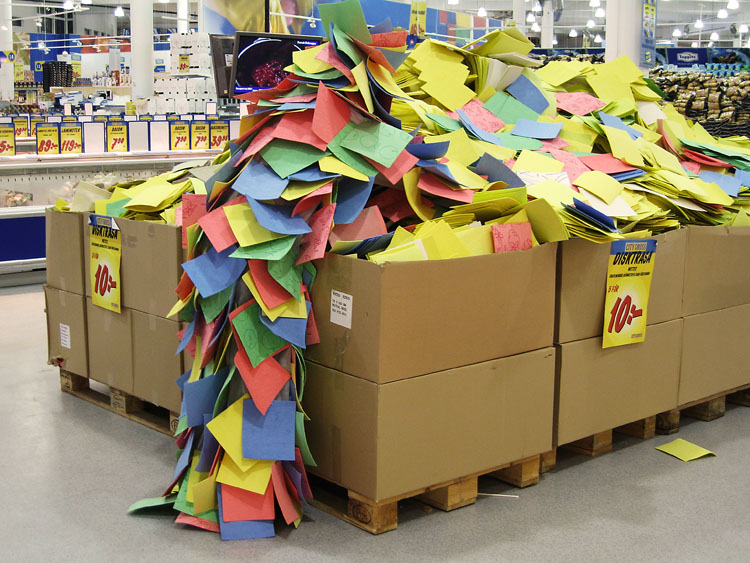
However, maybe the question is not the right one, maybe it is not about the rules or regulations. Maybe it is about the agency of the user? What if te question were, what do you want to use it for, could it be used for this? To make a proposa instead of asking how, completely changes the dimension and the dialogue and unlocks a potentially very fruitful conversation between different groups of actors.

Gestalten
Image taken from regardsdusoir / Urban Interventions, 2010, Cover by Gestalten.

The dilemma goes back quite a bitin history and it could be argued that is in parts a child of the modernist city planning. The city is designed as a machine that runs and functions. Its main purpose is serving the residents and visitors, which in turn makes them user. However, the clear lines of the functional city and the meticulous designed links and connections have reached not far enough. The 'Junkspace' (Koolhaas, R., 2002. Junkspace. October, 100, 175-190.) produced in between is taking over and users can't cope with 'Junkspace', they are trained to function in transit only.

To navigate in the modern urban environment creativity is needed and especially action is needed. It has to be an proactive approach, no longer as users citizens have to commute, but a actors. Space is no longer what it looks like but it is what it's used for.

In an awesome new Gestalten publication 'Urban Interventions' the editors Robert Klanten and Matthias Huebner outline exactly how this 'acting' in urban spaces could look like. And from page one (actually page 8) an incredible 'tour d' urbanism' takes you on a journey through other peoples reinterpretation of space. The mere density and variety of the projects presented makes you wane stand up and go out there into the streets and have some fun. It is one of those reading experiences that creap into your mind and things are no longer what they used to be.

Harmen de Hoop
Image by Harmen de Hoop / Sandbox, Amsterdam, 1996. Paving stones removed with sand and toys added to create a child's play area.

The book is organised in seven thematic areas that are: Urban Canvas, Localized, Atachments, Public Privacy, Advertised and Natural Ways. Within this structure you can find gems such as Brad Downney's Spontaneous Sculptures - Broken Bike Lane, 2008 Berlin, Slinkachu's Little People, earlier blog post HERE, or Tazro Niscino's temporary rooms usually featuring a public sculture as for example in 'Engel', Basel, 2002.
Other works are more practical like Harmen de Hoop's public space add ons that quip spaces with additional functionality. Similarly practical or transformative is Oliver Bishop-Young's 'Skip Conversions: London, 2008.

One of my favourites is the 'Urban Camouflage' reinterpreting the dimensions of activity in the (public)spaces of hardware stores.

Urban Camouflage
Image by Urban Camouflage / 'Lappen', performed in Stockholm in 2007 /


The book actually doesn't provide the reader with the normally introductive 'rules of the book' and the table of content. Also each project is documented only with the basic project information, but not with any sort of interpretation. Very much in the sense of the introduction it is an explorative approach and how one reads the book is up to each individual. You can read it from front to back though if you desire.

A must read for every urbanist! Go out and have fun, you are the city.


Klanten, R., 2010. Urban Interventions: Personal Projects in Public Places, Die Gestalten Verlag.

Selasa, 07 September 2010

Of Foxes and CCTV Cameras - Afterlife of Urban Areas

Every now and then one walks into a piece of art that is really fascinating. Usually this happens when lest expected or one expects nothing at all. So it happend only this weekend upon a visit to the Tate Modern.

While the large Turbine Hall is currently empty awaiting the upcoming installation of the Unilever Series by Ai Weiwei to open on 12 October 2010, there was (last day on the 05.09.10) an exhibition on by the Belgian artist Francis Alys. The exhibition was under the title 'A Story of Deception'.

nightwatch01
Image by single-blogs / The video installation 'Nightwatch' by the artist Francis Alÿs. Francis Alÿs’ The Nightwatch was made by releasing a fox into London’s National Portrait Gallery and following its movement through the galleries using the museum’s CCTV system.

As the Tate introduces the artist: "Alÿs’s work starts with a simple action, either by him or others, which is then documented in a range of media. Alÿs explores subjects such as modernising programmes in Latin America and border zones in areas of conflict, often asking about the relevance of poetic acts in politicised situations. He has used video projection and film but also spreads his ideas through postcards. Painting and drawing remain central to his work too."

For me the surprising moment came with the work 'Nightwatch', a video installation with 20 monitors all showing recordings of different surveillance cameras at the British National Gallery. It is quite a arge installation, but at the same time very simple and quite. The empty rooms the calm after the daily storm of thousands of visitors. It was not so much the 'Night at the Museum' type of reference that came up, but more the sort of 'A Dogs Night' type of idea.

And yes there it is a fox enters one of the rooms. It sniffs here and there tries this corner, sneaks round the bench and off in to the next room. It appears on the next screen where it goes straight through into the following room, exploring. Quite exciting this must be, not only for the fox but for the director and the insurance representative.

invasion-urban-foxes
Image taken from the Guardian / A fox on a London street: the highest density of foxes is now found in our cities. Photograph: BIGPICTURESPHOTO.COM

The work is explained as a piece to comment on the rising numbers of CCTV cameras that watch our every moves. There are now more cameras installed in London than anywhere else on earth and counting. The discussion is ongoing, but as the artist righty points out this sort of 'urban infrastructure' has already grown into our experience so much as a certain acceptance level is reached. It is no longer questioned or discussed, it is taken for a fact or only raised if it is not present. The promised security that comes with it as a label is enough of a promis.

For me this is one side of the work, but there is another more poetic side to the fact that the fox has come to see and there i something going on while we are not there. It is not just left empty, clean and tidy awaiting the next mornings bus load of tourists. The gallery has an afterlife, something hidden, beautiful and promising. Instead it points at a more complex whole where the view the individual has is only part of the picture. It needs at least twenty views and even then we loose track of the fox as it trails of into not displayed spaces of the house.

reynard
Image taken from askbiblitz / Reynard the Fox at the court of King Noble, celebrated Biblitz forebear, by Wilhelm von Kaulbach, from Geothe's Reineke Fuchs, 1846, the frontispiece of a new Biblitz favorite, In Praise of Flattery by Willis Goth Regier.

The fox also stands for a number of things, not only as recently here in the local and national news portrayed return of the wile animals to the urban desert. This aspect of the adjusting wild animals is one side, but the fox also stands for a clever and very sly animal character. It has both wily and villain sides to it. THat it survives or even thrives in urban areas is not at a surprising. already in very old stories of fables the fox character often coexists or even overtakes the humans if not destroyed with brut force as in for example fox hunting.

The discussion around the private or public domain and the 'public observation' of space as in CCTV, in this sense makes perfect sense in combination with a fox. As a quote form (Robert Darnton, "Peasants tell tales: the meaning of Mother Goose" in The great cat massacre and other episodes in French cultural history. N.Y.: Vintage Basic Books, (1984)) demonstrates: "Some historians argue that the fox came to symbolize the survival strategies of European peasantry from the Medieval period to the French Revolution. Peasants admired guile and wit needed to outmaneuver the powers of aristocracy, state and church, just as they saw the fox use these same qualities to raid their livestock under cover of darkness." Maybe this is a strategy to adopt in urban spaces a lot more. Instead of adjusting our lives to the omnipresence of the 'public' observation the secondary, tertiary live/perspective of the city has to be activated as a call for more responsibility and negotiation.

Watch the full 18min fox clip HERE, unfortunately on a single screen all cut into one. Movie description: A fox named Bandit, was let loose by Belgian artist Francis Alys as the gallery's surveillance cameras recorded his every move for his latest work. 18min video installation.