Tampilkan postingan dengan label sustainability. Tampilkan semua postingan

Senin, 07 Maret 2011

Book - [on farming]

'Bracket : architecture, environment, digital culture' is a new book seriespublished by Actar with the first one [on farming] published in summer 2010. The series is a collaboration between InfraNet Lab and Archinect. The publications are designed by thumb. The edited series is based around a specific topics, but works with contributions. Each edition starts with an open call for entries.

The Old Farmer’s Almanac
Image taken from bracket / Cover of the Old Farmers Almanac no 103. The Old Farmer’s Almanac can be accessed online for the most up todate weather forecasts.

The publication is an Almanac, a yearly publication. For this topics one important reference is of course the 'Old Farmers Almanac' the yearly planting and weather forecast guide for farmers published since 1792, and this is how the edition starts. With this the connection between farming, science, landscape and urbanism.

Farming has been a trending topic for the past six years in landscaping, urban design and architecture. This is partly nostalgic, but there are many practical or sustainable interests involved too. Even though farming is no longer farming, the topic is on a wide range of issues woven into the current discussion of urban planning not least because of the blurred boundaries between rural and urban or the larger cale infrastructural linkages between the two.

Microcosmic Aquaculture
Image taken from bracket / Microcosmic Aquaculture Bittertang (Antonio Torres and Michael Loverich). We imagine a future where the vast and deep expanses of the ocean will teem with overabundant floating gelatinous reefs. Humans will be nourished physically and aesthetically be encouraging new floating worlds of reefs that sustain large quantities of harvestable wild and captive fish. Farming in this project is not viewed as a monoculture but the creation of a new ecology where wild and captive wildlife are ’raised’ and their aesthetic potential is enjoyed by future divers and fisherman. From Bittertang, Antonio Torres currently tastes new flavors and Michael Loverich explores frothiness in Bushwick, Brooklyn.

This is outlined by Charles Waldheim in his introduction 'Notes towards a history of agrarian urbanism'. The discussion is structured into six chapters: tiling/seeding, grafts/hybrids, plots/allotments, harvest/yield, ploughs/combines and crop rotation/sequencing. Overall there is a strong focus on design and the discussion thereof. In fact the publication really wants to be a design almanac.

With the extended mix of projects and writings this new format can really contribute a slightly different format. It is not a magazine and not a book, but sort of manages to get the best of both. With the open call there is a broad range of perspectives covered ont he topic, but with its extended content projects are not reduced to just three renderings and image captions. There is room for a proper discussion here.

In this sense the contributed project cover all areas, ranging from Globalisation issues gobalgalisation, to faming in urban areas Nomadic Allotments, the harvesting of the oceans Microcosmic Aquaculture Bittertang or the colonialisation of the skies Cloud Skippers.

Microcosmic Aquaculture
Image taken from bracket / Cloud Skippers
Studio Lindfors (Ostap Rudakevych and Gretchen Stump) Cloud Skipping is about harvesting the resources of earth’s atmosphere. By harnessing the tremendous energy of the jet stream, Cloud Skippers imagine a community of adventurous pioneers who leave the surface to drift amongst the clouds in machine-like dwellings designed for gliding. Studio Lindfors explores the contours of imagination.


The next bracket edition wil be [goes soft], on: "racket 2 invites the submission of critical articles and unpublished design projects that investigate physical and virtual soft systems, as they pertain to infrastructure, ecologies, landscapes, environments, and networks. In an era of declared crises—economic, ecological and climatic amongst others– the notion of soft systems has gained increasing traction as a counterpoint to permanent, static and hard systems." However call for submission has closed now. Editors will be Neeraj Bhatia and Lola Sheppard. The jury for Bracket 2 includes Benjamin Bratton, Julia Czerniak, Jeffrey Inaba, Geoff Manaugh, Philippe Rahm, Charles Renfro.

White, M. & Przybylski, M., 2010. Bracket 1. On Farming, Barcelona: Actar.

Senin, 07 Februari 2011

Book - Contemporary Green Buildings in China

China is going through massive changes at the moment ranging from economy and society to culture. The bilt environment is definitely also part of this. Was it just four years back only about bringing prestigious names and projects into the country has this evolved into a wide ranging ecology and sustainability trend. Probably fueled by the western input, Cina has leapfrogged directly into the sustainability discussion and this directly influences the project planing and delivery.

A lot of projects are now not only seeked for their architect's prestigious name or the avantgarde design, but marketed for its sustainable value. If this goes together even better.

Politically China has already implemented long term strategies on how to develop expected growth sustainable with the twelfth Five-Year Plan and in 2010 also proclaimed ambitious climate targets. Since buildings use about 40% of the total energy consumption the built environment is an obvious starting point to reach such standards.

A new DOM Pulishers publication 'Contemporary Green Buildings in China - Art and Architecture for Sustainability 2000-2010' is drawing a portray of the trend in sustainability architecture in China. The editors Christian Dubrau and Li Xiangning are not at all short of examples, on the contrary list is impressive.

The publication is largely informed by the project 'Germany - China moving ahead together' centers on modern and future oriented development plans. Part of this is the forum 'Urban Academy' which builds a platform for specialists focusing on social development and urban construction development in cities today. 40 architecture project are showcased, but integrates a series of art projects that challenge the same topic.

This partnership between the two countries is of course an interesting one. Germany with a far developed culture of sustainable discussion but also practice has a lot of expertise to export to China. Of course the challenge is to adapt the practice and technologies to the specific need and environment.

The projects discussed in this book cover a broad range. This starts with two Steven Holl projects (two of his books discussed earlier Urbanisms and Hansun) the fabulous Beijing Moma Apartment Complex and the massive Vanke-Centre. There are of course quite a few urban examples, together with a short discussion on sustainable urban planning approaches, but then there is also a range of refurbishment and revitalise as well as rural projects together with some community based projects.

One of the very interesting urban projects is the Ningbo Museum. A gigantic structure on an artificial hill. The area was cleared for an urban extension and dozens of rural villages were destroyed. On the site of formar rice fields, parts of the structure are bamboo concrete formworks and the rest ist built from bricks recycled fromt he former village houses.

Ningbo Historic Museum
Image taken from ArchDaily / Ningbo Historic Museum / Wang Shu, Amateur Architecture Studio

Two of the more rural projects that are very fascinating are the 'Maosi Ecological Demonstration Primary School' (not sure what the name is pointing out) and the 'Namchabawa Visitor Centre' by Standardarchitecture.

The school project was developed by the Department of Architecture - The Chinese University and build together with local builders as a community project.

Maosi School
Image taken from DomusWeb.it / The project emphasizes a scientific and transferable methodology: condition analyses, computer simulation experiments and field construction.

THe visitor centre by Standardarchitecture is a project in Tibet about 2900 meters above sea level. It is located at the entrance to an important pilgrim destination. The project similar to the Maosi School seeks to blend in with the landscape, but especially with the local culture. This is realised quite successful in both projects and does show a new type of Chinese architecture, a much more engaged and interested attitude the architects show here.

namchabawa-visitor-centre
Image taken from archinfo.it / The center is located in a small village called Pai Town in Linzhi area in the south-eastern Tibet.

One thing that this publication definitely achieves is for a change to document an show a more subtile side of Chinese building projects. What publications so far usually have focused on is the size, the speed, the change or the costs. Such and approach tends to overlook the quality and sells buildings as consumables. What can be learned from 'Contemporary Green Buildings in China' is that there are good quality buildings with a interesting architectural style being built in China today. This is finally moving reports about China's built environment beyond bilboard architecture towards a substantial development.

Debrau, C. & Xiangning, L., 2011. Contemporary Green Buildings in China: Art and Architecture 2000 bis 2020, Dom Publishers.

Jumat, 15 Oktober 2010

Selasa, 12 Oktober 2010

Techno-friendly or Techno-lazy

----
A guest post by Luis Suarez from estudio-arq, contributing to the second Ecological Urbanism discussion hosted by Annick Labeca, Taneha Bacchin, DPR-Barcelona and single-blogs.
----


IMG_9399
Image taken from Saidaonline / Balloon helps Parisians breathe easy By Jim Bittermann, CNN September 20, 2010 9:15 p.m. EDAir de Paris balloon tells Parisians whether the quality of the air is good, bad or indifferent.

----
Click the image and read this contribution on DPR-Barcelona
----

Rabu, 12 Mei 2010

Ecological Urbanism - Redesigning the City 2.0

Spearheaded by the current energy, financial, and climate crises the sustainability agenda has called upon planners, architects, and urban designers to rethink profoundly the ways in which we build our cities. This, however, is not the first time when modern society is faced with such an imperative. Roughly one hundred years ago, in the beginning of the twentieth century, the explosive growth of cities during the industrial era posed a similarly overwhelming challenge. Thus, before we embrace wholeheartedly and without reservations the new emerging paradigm of sustainable design, it is worthwhile to consider the historical experience of western society when faced previously with the heroic task of redesigning the city.

The unprecedented rate of urbanization in Europe and North America towards the end of the nineteenth and the beginning of the twentieth centuries, produced a number of severe urban problems related to congestion, overcrowding, pollution, and public health. The western civilization produced two strategies for addressing these issues. The first one was an instinctive response based on the idea of decentralization. Thus, over the course of the twentieth century, the processes of suburbanization were effectively fuelled by a confluence of economic, cultural, and political forces stretching the boundaries of cities to engulf ever-greater patches of their surrounding landscapes. The second response to the challenges of rapid urbanization was based on the principles of the emerging modernist movement, putting its faith in the application of science and technology as a way of combating all social ills and advancing society forward into a new era of universal progress. In the context of city planning, this line of thinking called for massive reorganization of the urban fabric with the goal of increasing the efficiency with which cities performed their functions.

Image taken from Integrated Sustainable Design / In North America, more and more of the landscape is being converted to what has been called the wildland-urban interface, where urban sprawl takes over natural landscapes, as seen in this aerial view of the expansion of Albuquerque, New Mexico into the surrounding desert landscapes.

During the twentieth century, the two strategies (suburbanization and modernization) were applied simultaneously throughout the western world. The market-driven economies placing emphasis on suburbanization, and the central command-driven societies emphasizing modernization defined the two extremes of this range. It should be noted that to a great extent, both of these strategies achieved their goals. They reduced overcrowding, rationalized and improved the delivery of urban services, and offered to a great share of urban residents better quality housing (both in the form of suburban homes and high-rise urban dwellings) compared to the slums and squatters of the nineteenth century industrial city. However, both of these strategies created their own set of urban problems, which became very obvious toward the end of the century. The fallacy of modernist planning (the separation of uses leading to the demise of urban vitality) and the negative social, economic, and environmental impacts of urban sprawl are extensively documented in urban literature and need not be recounted here.

The point that I am trying to make is that we should examine very carefully the principles of sustainable urban design before it is too late to deal with its unintended consequences. I am afraid that efforts for such critical evaluation are still lacking or easily drowned in the euphoria of embracing the new green agenda. My main concern is that sustainable design principles, if they are too rigorously applied, can easily become a dogma that can threaten the most salient feature of cities – the intensity and richness of social interaction reflected in the complexity and richness of urban form. This can happen on several fronts and disturbing parallels could be drawn with the dawn of the modernist movement.

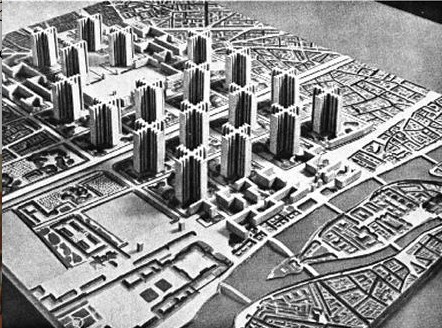
Image taken from arc1.uniroma.it / Le Corbusier, Plan Voisin, Paris 1935.

One of the most alarming overtones heard among the ranks of the most radical sustainability proponents is the notion that the severity of the environmental crisis, coupled with the needs of today’s profoundly transformed society, call for a complete redesign of the built environment. The rejection of the past and its structures is a familiar rallying cry of the modernist thinkers, best exemplified by Corbusier’s Plan Voisin. Luckily, most sustainability proponents exercise considerably more constraint in their public proclamations, but one is often left with the impression that appreciation of the existing urban fabric does not rank very high on the sustainability agenda.

Related to that is another point of concern deriving from the narrow interpretation of sustainability. Quite frequently, particularly during the last couple of years, sustainability is equated with minimising energy and resource use. I am afraid that applied to the urban realm, the dictate of resource efficiency can produce similar outcomes to those generated by the push for greater functionality which dominated modernist city planning during the previous century. Following such rationale, for instance, one can easily make the argument for the wholesale replacement of the energy inefficient historic housing stock of many cities around the world.

Another analogy between modernist and sustainability ideologists is their shared belief in technology as a main tool for accomplishing societal goals. This time around, the reinstatement of technology as a liberating force comes not in the form of a shiny machine, but as a delicate organic membrane wrapped around the body of the building, a network of sensors draped over the city governing the self-regulation of its interlinked systems. The digital delirium of the twenty-first century has replaced the fetishism of the machine championed one hundred years ago.

Recently, the notion of flexibility and fluidity characterizing natural systems has been pulled in to serve as an inspiration of architectural and urban design. The fluency of space, both interior and exterior, has been emphasized as form-shifting buildings and nomadic public spaces adjust to the ever-changing requirements of a highly dynamic urban reality. The permanence of architecture and the built environment, one of the city’s most reassuring psychological traits, is replaced by an overly responsive environment eager to please the users in whichever possible way.

These are just a few thoughts, admittedly rather dark ones. Overall, I am rather skeptical of the ability of societies to learn from the past. Yet I hope that the experience from the attempts to redesign the city during the last century could bring some humility and insights to our efforts toward sustainable design.

This Guest post by Kiril Staniov forms part of the discussion in the single-blogs series on Ecological Urbanism.

----


Kiril Stanilov holds a Professional Diploma in Architecture from the University of Architecture, Civil Engineering and Geodesy, Sofia; a Master of Community Planning from the University of Cincinnati; and a PhD in Urban Design and Planning from the University of Washington. From 1998 to 2008 he was an Assistant and an Associate Professor in Planning at the University of Cincinnati where he taught courses in urban design, physical planning, and contemporary urbanization.
Kiril Stanilov’s research interests are centered on explorations of contemporary patterns of urban growth and change, and the role played by public policies in shaping urban form transformations.

Sabtu, 08 Mei 2010

Sustainability and Social Context

"In nature, organisms and species coexist in an ecosystem, where each species has its own place or niche in the system. The environment contains a limited number and amount of resources, and the various species must compete for access to those resources, where successive adaptations in one group put pressure on another group to catch up (e.g., the coupled phenomena of speed in the cheetah and evasive agility in the gazelle). Through these interactions, species grow and change, each influencing the others evolutionary development. This process of bi-adaptive relationship (in some cases can also assume a form of cooperation and mutualism) or reciprocal adaptation is know as Co-evolution, i.e. the evolution of two or more competing populations with coupled fitness."
Vitorino Ramos [1]

Image by Ben Fry All Streets 

"Ne quid Nimis" [nothing in excess ]

Sustainability can be, aside a trendy tag, a desirable life perspective with high impact within our cities system as long as we make a personal task. Luis Suarez pointed rightly in his recent post when talking abut individual consciousness.
Individual behaviour (usually manipulated by industrial consume model and mass media) has important consequences in the process of co-evolution between techno-sphere and the biosphere, as long as more population demands more resources. The crucial problem is not population growth, but the fact that population  keep consuming resources in an unsustainable way. There are sectors of world population that constantly generate pressure on demanding more resources
only to maintain their lifestyle.
The concept of ecological footprint is very instructive as indicator of this phenomenon. The ecological footprint is a measure of how much
biologically productive land and water an individual, population or activity requires to produce all the resources it consumes and to absorb the waste it generates using prevailing technology and resource management practices. 

Image taken from Nicholas Feltron web-site / FOOD (detail) from the Feltron Annual Report 2009. 

At this point, most people have the belief that science and technology will find the solution and take us through the path of "sustainable development." Technique and technology are important, as long as they are reinforced by common sense. If we maintain the same consumption patterns while increasing technological efficiency what actually occurs is a rebound effect known as the Jevons paradox which states that resource consumption increases when increases its efficiency. It means that when efficiency improves, production increases and therefore, consumption. Here, we can quote José Manuel Naredo, when he pointed "This technological optimism, in fact extractive, is therefore incompatible with life." If we consider that "the second law of thermodynamics can not be ignored."


Image taken from Masdar Media Center / Technique and technology for "new sustainable cities" at Masdar. 

The growth limits do not pass through the optimum use of resources, neither by improving technology. The boundary is defined by the law of entropy, that describes the degradation of matter and energy in the universe. In fact, economy is an open system that can not function without the input of energy and materials. According to Joan Martinez Alier[3], the conflict between economy and environment can not be solved simply with phrases such as "sustainable development", "eco-efficiency" or "ecological modernisation". The clash between economy and environment seems to be inevitable, and Martínez Alier adds that therefore, we still needs to invent something new, a vision that does not depend on politics, but rather on social movements that reinforce it.

Proposal for a social approach to sustainability

Nicholas Georgescu-Roegen pointed that in the future the fundamental scarcity would not be due to energy (given the existence of solar radiation), but depending on materials, taking in consideration that Earth is an energy-open but materials-closed system. The question is not whether the 21th Century cities may be sustainable or not.  The crucial fact is that our entire system of production and consumption needs a deep revision. This can be achieved as long as we abandon "growth rates" and "development" (even if sustainable) as economic and political objectives and focus on other convivential and relational goods, which consequently will be reflected in all our achievements, including architecture and our cities. 

A clear awareness of the material and energy limits of our activities is essential to reach a balanced relationship within the system. It is possible that this will lead to courageous proposals as to stop or reverse the growth of our cities. Changing our mechanical growing paradigm and our production system would result in the conversion of economic activity as we know, which is deeply rooted in our collective unconscious as synonymous of progress. 

In this process of assimilation and conversion, will be crucial the community support to absorb the countless number of people who need to change their labour activities. At this stage starts to make sense to encourage activities based on convivential exchange of goods (in the sense pointed by Ivan Illich) [4], labour support and network assets in the creation of open source systems that allow appropriation and adaptation to the specific situation where apply (e.g. time banks, local currencies, barter of services, open source software).

Image by dpr-barcelona / Wellness' Thermodynamics.

We have proposed an open formula, which allows new variables in case anyone wants to contribute. With didactic vocation, it shows the increasing importance that relational goods must have against other "values" that until recently we thought unassailable.


[1] Ramos, Vitorino "
Charles Darwin’s Scottis kilt " http://chemoton.wordpress.com/2010/05/05/charles-darwins-scottish-kilt/. Web May 07 2010.
[2] Global Foodprint Network. http://www.footprintnetwork.org/en/index.php/GFN/.
Web May 06 2010.
[3]
Interview points by Monica Di Donato CIP-Ecosocial http://www.rebelion.org/noticia_pdf.php?id=81315. Web May 06 2010.
[4] Illich, Ivan. "La Convivencialidad" (Tools for Coviviality) . Barral Editores. Barcelona 1978.


This Guest post by dpr-barcelona | Ethel Baraona + César Reyes forms part of the discussion in the single-blogs series on Ecological Urbanism

---

dpr-barcelona is an innovative publishing company based in Barcelona, specialised in high quality architecture and design books. With an international scope and founded by two architects, their titles vary from monographs and documentation of buildings to historical studies, collections of essays and dissertations. Showing a clear innovative way to bring the contents to the public, their projects transcend the boundaries between time and space from conventional publications, approaching to those which are probably the titles of architecture in the future.

Jumat, 07 Mei 2010

Sustainability and the Social Context of Ecological Urbanism

Ecology is one of the most popular words nowadays. We all throw terms in frequently like sustainable, environment friendly, renewable, efficiency, green, climate change. It is now important for Companies, governments, politicians, individuals; to turn green. Some really respect the cause and care about themselves and the planet. While others take advantage of the situation; “green” is now a profitable brand. For good or for bad ecology is know trendy.

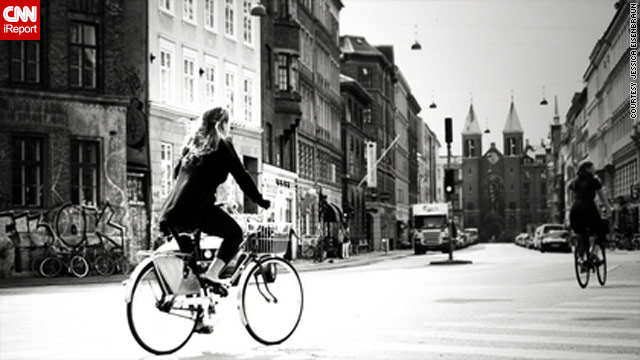
Image taken from CNN / In Copenhagen, Denmark, which has a reputation for accommodating cyclists, Jessica Eisenbraun gets her exercise riding around the city on her steel bike, which is older than she is but easy to maintain. Biking is the fastest way around the city, she says, when you consider how long it would take to park a car or take a bus.

“GREED Vs GREEN” Our contemporary societies are evolving from “greedy to greeny”. Bill Maher, an american comedian and critic said in his show; “greed isn’t good! In fact, is the common threat that runs through all of the problems that this country faces, from financial meltdown, to healthcare, to climate change. Americans will do anything to each other for money...” Twenty years ago greed and consumption were the key factors in any society. Things seem to be changing slowly. Unfortunately we needed get scared the hell out to evolve! We all now fear; Climate change, terrorism and the economy. As a result society is getting a conscious.

Individual consciousness seems to be the answer for this mess. Consciousness about our ways of life by consuming less and taking care of our selves and the environment. Italian Architect Andrea Branzi in his “Weak Metropolis Lecture” at the ecolological urbanism conference in Harvard talked about our attempt to change cities with major architecture projects, and how we must instead focus on smaller scale projects that will be able to penetrate households and cultures. It is in the conscious of the individual that ecological urbanism finds its roots.

Sustainability is the capacity to endure independently. The term is often used in architecture and urbanism for projects that respect or use a minimum of natural resources, the same term can be applied on individuals. The sustainability of the individual must be approached on how the individual takes advantage of the environment with the minimum impact over it. Environment relating to the geographical location, social and cultural surroundings of the habitant. This means that Andrea Branzi arguments are very strong. Even though a large amount of resources could be used in the construction process I do believe that well thought macro projects can bring benefits to a city and small projects like roof productive gardens (not only grass!) in each house hold can definitely create a huge difference on the sustainability of a city. Small viral green projects carried out at a house hold scale or at an individual scale will change the dynamic of the city. It will bring better quality of life to the habitants and it will lower the resources that the city requires.

Image taken from civileats.com / Roof of Abundance, a repot from the frontline of roofgardening in New York by Paula Crossfield. Details can be found in the ‘Roof Garden Rookies’ Category.

An informed individual is a conscious one. Nowadays we can find several web pages that will inform and measure the carbon footprint of individuals or small businesses. For example myfootprint.org, or one that I recently discover and that I really enjoyed is www.changinghabbits.org The 'Changing Habbits' project was initiated, designed and developed by Prof. David Walker and Prof. Rob Holdway of Giraffe Innovation. By responding to some easy questions this website will calculate your carbon footprint and will illustrate it in a fun way, at the end of the exercise you will have a perspective of your house hold habits and some simple tips on becoming greener and on improving your quality of life. The message is simple, wrong habits will make you a fat, ugly and unhappy person! So from a greedy materialistic frightened society we must change our ways into a conscious society. We all are ecological urbanists.

Image taken from changinghabbits.org / cover illustration.

This guest post by Luis Suarez forms part of the discussion on Ecological Urbanism as an single-blogs series .


---
Luis Suarez was born, in Bogotá, Colombia and graduated from The University of Florida in design, construction and planning in 2005. He received a master in science of urban design from The Bartlett School of Architecture, University College London. He is currently pursuing a Masters in Bioclimatic Architecture from The Isthmus School of Architecture for Latin America and the Caribbean. He is designing and building multiple projects in South and Central America with his established firm, Estudio ArQ.

Rabu, 24 Maret 2010

Book - A Manifesto for Sustainable Cities

A manifesto for sustainable cities is definitely a task with two diverting possible outcomes to it. On one side this is a winner, because everyone is talking sustainability and if you can offer this bound knowledge on the topic you are clearly up to the task. However, there is also the other side, you can only fail with this approach. It has been over used and become a real media word without meaning or program. Furthermore some sort of resignation has settled and a lot of practitioners think it is just too complex to fit in one field of expertise.
This book here with the title: ‘Albert Speer & Partner: A Manifesto for Sustainable Cities, Think Local, Act Global’ by Jeremy Gaines & Stefan Jaeger, published by Prestel in 2009, is probably such a candidate for this kind of black and white judgement. It is either great and you love it, or you will find it terrible and you don’t bother. However, the topic is kind of urgent and it has to be taken seriously globally to tackle the issue and every little helps.
This book is not a little, but 220 pages think and therefore must have something to say?
It is organised in ten chapters each in command style what you have to do and how you have to do it. It looks kind of more like a manual than a manifesto. The content is put together from practice examples drawn from all over the world, both in house Albert Speer & Partner (AS&P) projects and external projects by leading practices.


Image by AS&P, taken from german-architect / Artist impressio nof the proposal for Abuja, Nigeria. Note the six lane boulevard running down the length of the proposed development. This not only creates two parts or reminds us of Haussmanns Paris, but it also is clearly planned for individual traffic - cars - sustainable? More ilustrations can be found HERE.

The guys at Albert Speer & Partner really seem to know what they are talking about and they know it so well that they have to tell everyone else that they know it. So what you get with the book, is a set of ten rules, and I have to stress the importance of these rules, on how to do it. I have to repeat it again, this book tells you how to do it and of course also tells you how not to do it. It comes as a surprise to actually find such an old school approach to the complex topic of sustainable urban design especially because planners and designer only begin to grasp the extent of the topic and the required complexity of processes needed to address some of the issues at hand. But with this publication in hand you are saved and with you the planet, if this is not sarcastic enough.
There seems to be a never ending list of complex interwoven topics that render this book impossible to acknowledge as serious beyond a marketing publication. The text starts right away in the introduction with a sharp critique on the Fosters and Partner project ‘Masdar’, the zero carbon city outside Abu Dhabi. I agree with the critique in some points, but why would you choose to open a book with such a statement? Is there such a need to establish this distance between oneself and the others, dealing with the same problems? Similar, at a later point, there is talking about the new Alianz Arena in Munich, a new Football Arena built for the World Cup in Germany 2006. AS&P somehow had a part in this project, but the actual architect is not once mentioned in the paragraph. And who do you guess the architect was? A famous architect of course and not Foster and Partner. Yes, it was Herzog and de Meuron. This strategy of not mentioning seems to go through the book and frequently not the whole context is revealed. Other examples can be found again in the introduction where the talk is of another mysterious zero carbon city, this time in the United Arab Emirates called Ras al-Khaimah, who do you guess is the project author for this one - O(h)M(y)A(?). The name of the architect must have gone lost somewhere on the way. Also in the paragraph ‘Icons and Idiosynchrasies’ where only specifically selected icons are presented, such as the Guggenheim in Bilbao, but with great care not mentioning the architect. More is in ‘Current Mobility Fosters Immobility’ with the example of the Curitiba Bus System but no reference to where it came from and who invented it.
Either it is a decision to keep the descriptions extremely simple and this information is considered as clutter or it is strategical non-placement of references that would distract from the glory of AP&P.


Image by AS&P / perspective view of the master plan for Changchun JingYue, Ecological City in China. Extreme axial organisation again, as in the previous example, while creating a lot of physical boundaries in addition with transport and water features. Surprising her is the lack of clarity regarding the definition of space or voids. The parcels seem to be developed under aspects of value and dimension along a grid of roads. The buildings are then detached isolated placed floating around inside the plot. It is only a diagram yes, but one that clearly states the road in with it the individual car traffic as its dominant factor,

The glory really doesn’t end here. You have probably by now understood that the book must be in ten chapters - reference, what comes in ten chapters down from the hill, somewhere in the desert? AS&P must also have picked it up somewhere in the desert as they ... sorry this is going to far, but yes The Ten Commandments are, according to Wikipedia: “a list of religious and moral imperatives”. As if this is not good enough, there is an eleventh chapter, the conclusion. This is the book killer, it is entitled: ‘Applying The Ten Commandments: Cairo’ ??? Is this some sort of 21st Century Christianization? (I am aware that the Ten Commandments do also play a role in Islam, but the context and the way ideologies are thought directly by the head teacher is truly astonishing.)
A note on the style of the text, it is surprising at times and lets one wonder who actually is telling the story here. From the first impression you would expect that this is some kind of a knowledge output by an architectural practice, they talk about what they learned and experienced. But then after a few lines you come across the first third person reference and then follows the first quote of someone, apparently a board member of AS&P. After a few times this lets you wonder who is writing here. Do architects also have ghost writers?

Overall there is very little good to say about the style of the book. However, it has to be said that it covers different aspects of sustainability, illustrates them and through this can offer a perspective on the topic. It is just that one has to like the style to like the book, I guess. This is a half hearted recommendation, but have a look at the book and see what you think of it.


Gaines, J. & Jager, S., 2009. Albert Speer & Partners: a Manifesto for Sustainable Cities: Think Local, Act Global, Prestel.

Senin, 01 Maret 2010

Book - Asia Beyond Growth

A heavy book about a heavy topic and in this case size matters. Since the book is a bout size and its content celebrates the vast extend of the land area covered or better involved one might understand the motivation behind the physical extension of this publication. However other factors might also play a part.
We are talking about Asia Beyond Growth - Urbanization in the World's Fastest-changing Continent by AECOM former EDAW is published by Thames & Hudson.
The book starts with what has been leading the debate about the future of urban design and urban planning for now three years: "Today, for the first time in history, more than half the world's population lives in cities ..." and it adds quite rightly, and this is then also what the books really celebrates on the following 484 pages: "... and most of these cities are in Asia."
It is sort of a monograph as the books author is AECOM former EDAW, a single planning and design firm. It is, however, not a documentation of their projects only, it is more sort of an extended report of experience and knowledge. It coincidently falls into place with the change of name. The company was formerly known as EDAW (all the projects and most of the experience dates back to the EDAW times) and has recently, late 2009 changed its name to AECOM, a publicly traded company on the New York Stock Exchange (NYSE: ACM). They are proudly presenting themselves on the website as: "Today, listed on the Fortune 500 list as one of America’s largest companies, AECOM has approximately 45,000 employees located in 100 countries."
The book however is about the companies work in asia an documents the drastic change, the massive amount of work done as well as the vast extend of individual projects. For this the authors make extensive use of photo documentation and graphs. And the publication seems to follows in the footsteps of well known publications that introduced this sort of graphical language, for example S,M,L,XL or Massive Change. This language seems to be at the moment very popular, i.e EndlessCity and I pointed this out recently in connection with the book Comeback Cities - Transformation Strategies for Former Industrial Cities published by NAi Publishers.
In twelv chapters the Authors discuss the challenges of planning in the Asian context and chare their experinces. THe photographs used to illustrate are a really big part of the book and there is also an online blog thatextends this and documents the photographers work for the publication work. You can find it HERE.
The problems faced by planners are very often similar. It is described in many examples through out the book. For example in the case of Shanghai: "These developments are often the scale of new towns, requiring comprehensive planning and amenities, but lacking the cultural or historical background that might lend the place a distinct identity." Surprisingly still a lot of examples are then developed in reference back to the European city which is in turn stylized as an ideal type. We have all heard these stories of groups of Chinese investigators being sent to Europe to measure and document villages or entire town to replicate them back home in Asia. An we have all hoped this might be a single case or an exemption, but this might be more often the case than hoped. This really fuels the important debate about creation of identity which, to a large extend urban design is about, is an ongoing process. Probably especially in the Asian context, the role of foreign practices, mainly western offices, probably is more important than usually discussed. In fact the discussion about cultural export and 'international style' is not extensive enough in most cases. It is primarily about size and money and recently about work and jobs and less about the culture clash, export of values, believes,f culture and knowledge. The burning question here is, how interactive and emancipated this collaboration is. Probably one could argue that it is not the role of the international practice to lead this debate, but it should be left to other to do so. On the other hand who could this be, architectural critics, academic sociologists or even publishers? I believe it has to be part of each and every project and it is to a large extend part of the role and responsibility of the planner to be involved in an ongoing discussion around the impact and extend of the project in progress. And of course all the other disciplines have to be involved too, and in the case here especially when it comes to a publication. The book represents a clear position whether it is explicitly discussed or equally explicitly absent. And for me this is the main week point of this publication. It is a documentation of multiple facets of the Asian growth, a nice picture book, a heavy weight in your bag and definitely a document of its time of a certain subject, but it is lacking this discussion of a wider context for not to ask for an explicit standpoint.
This includes other areas of discussion and is not limited to the debate about westernization of Asia through planning firms. It continues in through the trend topics put forward. What I mean for example is that often topics are presented very shallow and with an sort of innocent view. Take for example the topic 'It's all About People', already the topic is suggestive enough, there is no need for explanations, so the authors decide to illustrate it with photographs and minimal text. This text says:"In Asian cities, it is common for people to use the spaces between the buildings as outdoor living rooms. ... In many places, it seems, all pieces of the city are used for and by people." This is then illustrated for example with a fish market or a street with small mobile fast food stands. Not enough, it leads in directly the topic of the slums. Which is a bit odd in the context of what has been said about the topic: "In many places, it seems, all pieces of the city are used for and by people." and showing a photograph of lots of these slum hutches crammed into a tiny space between high-rise buildings and streets. Another example is the photograph of the little boy, shown full front, as he urinates onto the street to illustrate that people in Asia do not use the public toilets. This sort of, by the authors, pretended innocence, while showing material left open for interpretation in multiple contexts (one of them might be a wrong one) gives the book a strange taste, which is definitely not intended.
So to conclude, this is a book in a tradition of thick and heavy architecture books (if such a category exists) on a subject that has been dominating urban design practice and planning for the past decade (not clear at this point in time how it continues). It is rich on illustration through photographs, graphs of illustrative and sometimes suggestive character and text essays on certain subjects. It does, however, at times have this character of uncertain shallowness or unidentified innocence that can leave the reader in the dark about the real aim.


Image taken from webster.it / it shows the initial cover, where it still says edited by EDAW and Denise Scott Brown. I don't know what happened to this collaboration , since her name does not come up in the publication I have here. Only some of the chapter titles that start with 'Learning from ...' suggest a connection, but could be a reference.


For an alternative view read Adrian Hornsby's review of the book.


AECOM, 2010. Asia Beyond Growth: Urbanization in the World's Fastest-changing Continent, Thames & Hudson.

Kamis, 25 Februari 2010

Book - Subnature the Other Side of the World

There are things and things in our material world, that are not the same. Some things, especially if they inherit the ability to change between different forms and states or even context, are contradictially received. This phenomenon is known in all areas, but it is particularly distinct in the context of the environment. More so because it is so consequently denied.
And I am probably taking it a little far here, but a great deal of the sustainability debate of the recent decade is related to this denial of context and integrativity of more than a century of constructing and theorizing environment. So in this context the debate about how and especially why we should build ecological or sustainable buildings and cities makes more sense. Because of the radical and to a large extend successful exclusion of anything unplanned, uncontrolled we now are doomed to sit out the debate around how to live a life on our planet and to learn to accept that everything is part of the plan even and particularly the planner. This is a tuff one, I know, but there is no return, we have to obey the culture we live in (@geno).
Beauty might lie in this. Louis Sullivan wrote a poem to one such banned commpanion of the environment:

"I made a little one to a weed the other day. I like weeds: they have so much 'style' to them and when I find them where they grow free they seem most interesting and suggestive to me. I think I'm something of a weed myself....And then there are so many of them, and they differ so much in shape, colour and arrangement; the form follows the function so beautifully as you would say. I wish I knew the names of the little rascals; then it seems to me, I could talk to them better." (David Gissen (2009), Subnature. p. 154)

In his book Subnature - Architecture's Other Environments, published by Princeton Architectural Press, the author David Gissen goes to a great length to shade light on different aspects of denial of context in the practical and theoretical construction of environment. It is a book that you probably wouldn't take first down from the shelve in the store, but not because it is not good written or pleasant looking (the opposite is true), but very likely because the topic puts oneself against so much practice and cultural conventions, that it might still be hard for people to take this step of acceptance.
It is worth it, moreover it is necessary and I believe this publication is only the start of the theorization of a movement that has developed tools and practices to allow numerous completely forgotten dimensions to feed into the man made environment.
Gissen has positioned the book very cleverly out of the main line of commercial sustainability debate and with this can avoid all the unnecessary discussion around the education of professionals and can concentrate on actually discuss concrete examples, approaches and theories on this subject.
The book is organised in three parts. Part one is on darkness, smoke, gas, exhaust; Part two is on dust, puddles, mud and debris; Part three is on weeds, insects, pigeons and crowds. A not on first blink self explaining structure, but as you dive into the content a skeleton that starts to make sense as Gissen continuously feeds the reader with examples. An this is really the strength of the book. The author has illustrations for most of his arguments and subjects. This is really brilliant and pulls the reader in immediately. It is not one of these "I tell you to to this!" books, but a real discussion of the subject matter. THe examples are not presented as right or wrong, but as a way of reading something, leaving it open for the reader to read more into it or read something completely different from it. This is something very few books mange to do, creating this platform for an debate between professionals.
For the conclusion, I realize that I have actually given away very little on the content of the book, but I guess this is a good thing in this context. There is little point in me repeating what David Gissen has put so beautifully and engaging in print. This is simply a must read, if you are prepared to take the plunge and be prepared to see the world, and definitely your work, with different eyes.
For further and detailed reviews visit Landsacpe+Urbanism or Archidose or see the authors blog for a 11 point list on Subnature.


Image taken from HTcExperiments / Alternative book cover, showing the work by Jorge Otero Pailos.


Gissen, D., 2009. Subnature: Architecture's Other Environments 1st ed., Princeton Architectural Press.

Selasa, 02 Februari 2010

Green Police - the Power of Recycling

The topic of climate change is currently one of the top topics. However the acceptance of facts of a human involvement are only slowly settling. One of the earliest observations of the environmental temperature rise was undertaken by Charles David Keeling at the Mauna Loa Observatory. He has produced the most striking graph used in the debate from early on.

keelingCurve.wHj48kFfrJTG.jpg
Image taken from Scripps Institution Of Oceanography / The Keeling Curve

The latest development in the global debate has climaxed in the United Nations Climate Change Conference COP15 held at the end of 2009 in Denmark. There were no real conclusions or immediate actions to the problem at hand. However, the fact that climate change is accepted as a global issue is already something.
Besides the important politicians talking, isn’t there something everyone can do? The buzz word here probably is sustainability, a term that is fluid and employable by too man different interests. It has become a empty phrase. Individual responsibility and action is probably the more powerful alternative, quite likely the only alternative there is. Greenpeace has published a starting guide HERE.
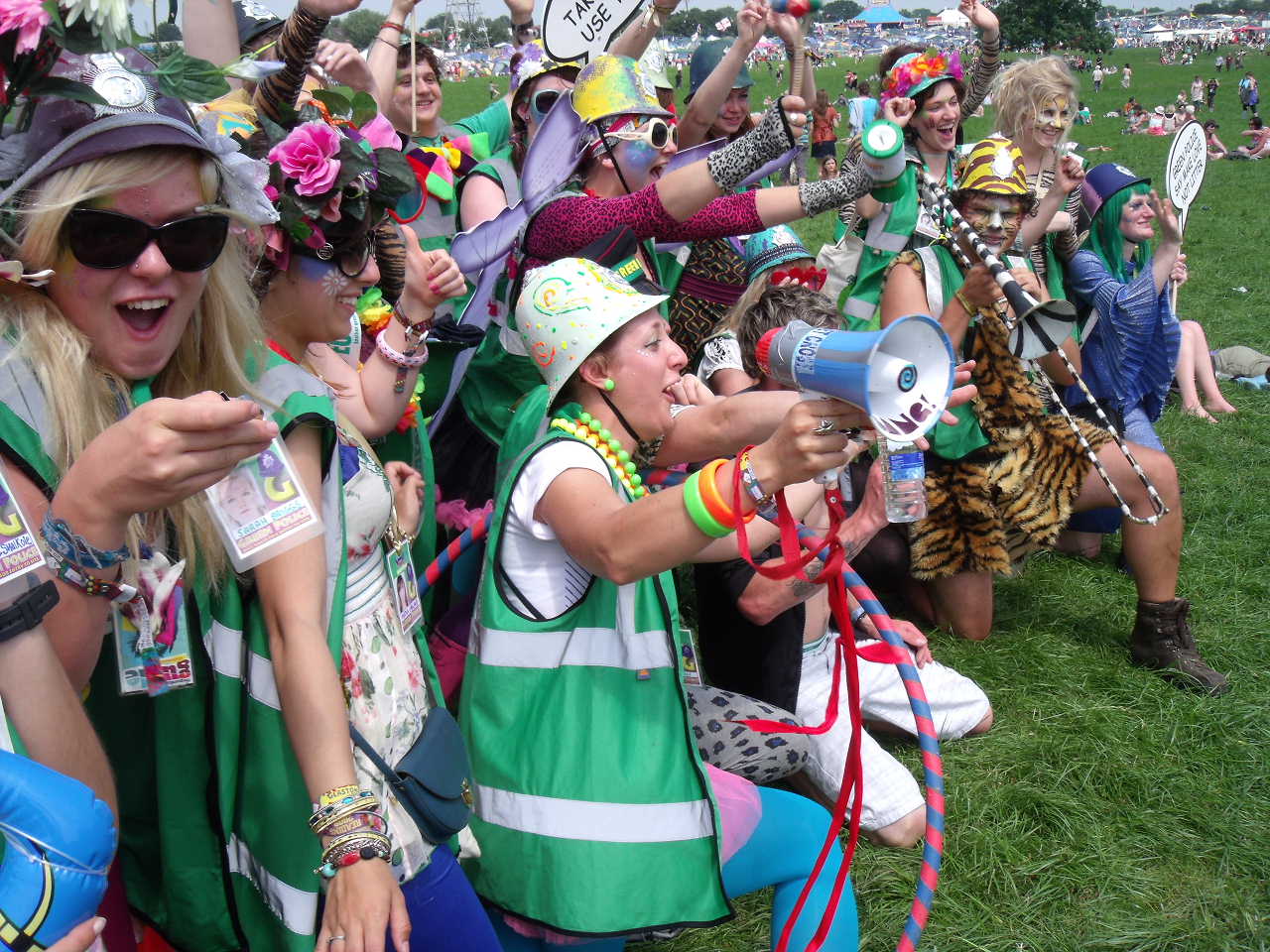
As a wider community based project the Green Police is an effort to tackle sustainability on an everyday level. The wiki states: ‘The modern Green Police are an environmental task force comprised of collaborative law enforcement groups assembled to crack down on emissions’ Details on the Green Police can be found on wikiAnswers, a great place for all sorts of questions. It is not at all a dull cooperation. The Green Police is for example active at festivals such as Glastonbury. So you have the possibility to combine a great festival and some work for the environment. You can sign up HERE to take part as a Green Police Officer at the upcoming Glastonbury festival 2010.

greenPolice.hvHc0Os27rCb.jpg
Image taken from musicGreen / Green Police can be a lot of fun


Found through musicGreen

Jumat, 30 Oktober 2009

Apocalyptica and the New City of Space

Last weeks the most disturbing science news headline was “How the city hurts your brain” circulating as new research that proves the evil of cities. The original article can be found at the Boston Globe.
It all starts with a very innocent introduction where the author says: “The City has always been an engine of intellectual life, from the 18th-century coffeehouses of London, where citizens gathered to discuss chemistry and radical politics, to the Left Bank bars of modern Paris, where Pablo Picasso held forth on modern art. Without the metropolis, we might not have had the great art of Shakespeare or James Joyce; even Einstein was inspired by commuter trains.” From this point it goes down hill. From spreading cholera to the argument that the before named artists eventually moved out of the city, concluding “ ... [the city] it’s also a deeply unnatural and overwhelming place” We’ll that is a statement, DEEPLY UNNATURAL! However, as we try to grasp the extend of the devastating news, the authors are quick with analysis and of course solution. It is all down to the city affecting the brain and a few minutes on the busy street will blow your memory and you start suffering from reduced self control (what does that mean?). Again with a very pointy argument, “that's why Picasso left Paris”. The excuse comes in the form of the acceptance that “The mind is a limited machine” while still concluding this, the first solution comes in the form of “One of the main forces at work is a stark lack of nature”. I am aware that this is not actually a solution , but rather an other analysis or hypothesis, but in its tone directly implies to be a solution. And it does not stop there it straight goes through the wall with the sledge hammer solving ALL! the problems: “...that hospital patients recover more quickly when they can see trees from their windows, and that women living in public housing are better able to focus when their apartment overlooks a grassy courtyard”.
WOW, now I feel much better and I am convinced we live in a better world.
It however comes to the first element I do actually very much agree with the authors, the fact that this kind of research comes exactly in time with the news (and of course the media coverage and interpretation) that now over 50% of the world’s population live in cities. Unfortunately it dives right back down with a sweet but unrealistic naive worldview of: “For a species that evolved to live in small, primate tribes on the African savannah, such a migration marks a dramatic shift. Instead of inhabiting wide-open spaces, we're crowded into concrete jungles, surrounded by taxis, traffic, and millions of strangers.”

I think I stop here, because the article goes on for another four pages, I hope I have missed the point of the article and if some of you read it all through, please let me know what I missed. The ‘leave a comment’ field can be found at the end of the post.

But actually there is another reason to stop at this point, because this one point is very interesting and important. We are living in a mainly urbanised world. Most of us live in urban areas and rising. The UN predicts some 70-80% by 2050. “The United Nation Population Fund, UN agency, says in a new report that humanity will have to undergo a “revolution in thinking” to deal with a doubling of urban populations in Africa and Asia. The UN continues to say that the number of people in African and Asian cities will grow by 1.7 billion by the year 2030. And worldwide, the number of city dwellers will reach five billion or 60 per cent of the world’s population (citymayors)“
‘Revolution in thinking’ is probably a more appropriate suggestion than to point out how bad our (western) cities are. Western city here is important if not to say European, because this is what I believe the above article is referring to. Conditions in other ‘urban’ areas in the world are dramatically different from what westerners call ’a city’. And I mean, to dig out a cholera example is pathetic. According to Wikipedia the first cholera pandemic reached London and Paris in 1832, a second one in 1849, the third Europe skipped, fourth in 1854 and a fifth in 1866 that was locally very much condemned as by then London was just about to finish its new water and sewage system (I guess it is still the same, but that is another topic). However you can see that since 1866 dramatic chances in the urban environment were introduced. I am aware that I also imply a lot here, but to bring it across in a similar style: the city was a much worse place. (We all know that this is a very difficult way to express thought about historical events and while being aware of the implications of the distorted and constructed past as seen from the present,
it might be much more complex, but we’ll keep things simple her for today.) To come back to the new challenge of the dramatic growth in urban population - a doubling of the city population in Asia and Africa - another example might be of interest. Thinking back to the last urban crisis this latest and now upcoming reaction very much reminds me of Haussmann’s renovation of in Paris or Ebenezer Howard with the Garden City.In fact both came after the Cholera pandemics. I am pretty sure, actually I was only waiting for the first such news to appear, that we ill see a lot of reactions to the ‘city problem’ coming down a similar route as the article quoted in the beginning of this post. It is all bad and we have to reinvent to solve it. Urban designer will be very quick to jump to Howard’s idea of the Garden City to have a readymade solution. Someone will dig it out.

PastedGraphic1.rJmkTHpyxw88.jpg
Image from Wikipedia - as published in "Garden Cities of tomorrow", Sonnenschein publishing, 1902

However to make it clear, I am not playing down the urgent and extend of the raising question. In the contrary, it is an urgent matter, especially because the urban planning profession in general and urban design and architecture (I add them here because they all think they can do both anyway) in particular is in an identity crisis with no consistent concepts available at present. The only thing that buzzes around is sustainability, but it’s got no content to it.

In an article on io9 Chanda Phelan presents how apocalyptic stories have changed in the past 200 years. She explains ”It's not the idea of Ending itself that has faded – that will be around until we are actually mopped off the face of the Earth. It's the actual moment of disaster, the blood and guts and fire, that has been losing ground in stories of the End. Post-apocalyptic fiction is a 200-year-old trend, and for 170 of those years, the ways writers imagined the end were pretty transparently a reflection of whatever was going on around them – nuclear war, environmental concerns, etc. In the mid-1990s, though, everything just turned into a big muddle. Suddenly, we'd get a post-apocalyptic world whose demise was never explained. It was just a big question mark.“ And she also points out that actually it was never about the end, but the new beginning. However she analyses that in the last 30 years there has been a decreasing interest in the why and how of the end, very often simply assuming that there was an end. Presumable, from my reading of it, the apocalypse was never about, it actually ends, but about narrating a sin or something stylised ‘problematic’ to actually urge people to change something in the present. Implying ”if you don’t behave now, something disastrous might, could possibly, eventually, maybe happen“. And in this sense skipping this part of the apocalypse is indeed a very dramatic change.

PastedGraphic2.DBxd1cIRZEzG.jpg
Image by Stephanie Fox - How the Apocalypse Will Happen - A Literary Chart

In this sense the attitude to the posed urban growth question would be, let’s skip the growth, the infrastructure demand, logistics, flows, identity, morphology, material, organisation, atmosphere, form, transport, colour, work, resource, governing, social, knowledge, communication, finance, and so on question and just build a New Cities for some 80 million people or maybe better a set of Garden cities, each with some 58’246.1 residents ?

So what to do?