With the days getting shorter and the temperature dropping we enjoy the last few autumn days. With this is is nice looking back to the beautifully warm summer days. Here is one of those heartbreakingly romantic summer day clips. Enjoy the 'Love from Southend-on-Sea' by Philip Bloom, shot with a Sony EX1 and Letus Ultimate. As Philip puts it; " short film that captures the feel of a day at a typical British seaside town". Music is by Charles Trenet "La Mer".
THe beauty of this clip for me is in the way Philip picks up on the characters he spots in the scenes. Lovely arranged with a lot of respect for the individuals, he creates a portrait of them in the scene as a whole. I love it. Watch it in HD and full screen mode.
Tampilkan postingan dengan label body. Tampilkan semua postingan
Tampilkan postingan dengan label body. Tampilkan semua postingan
Rabu, 10 November 2010

Jumat, 08 Januari 2010
Body-City a Relationship
The human body is inscribed into a number of cycles as we have seen in the broad field discussed above. Ultimately these patterns have a direct impact on any activities and social relations coming from the body, thereof also the shaping of the immediate environment. Furthermore this highlights the importance of looking at repetitive patterns as elements of the society in an overall sense.

Images taken from Wikipedia.
The relationship and interaction of body and city is the subject of direct investigation with the urbanDiary project. Through the GPS tracking of individuals in the city, the body movement is recorded on a city scale and visualises the extension of the interaction of the body with the urban morphology. Quite literally the record can be visualised as the body’s physical inscription onto the urban form. With the rhythmic constitution of the body in mind, this space ‘creation’ of the physical body is investigated.
In the more theoretical conceptualisation of the body, there is a great emphasis on issues of gender and sex. Although these are very important aspects, it would be too much to integrate it in detail.
If the body is read in connection to the city, the importance of these external issues is emphasised. The body shapes the city in a literal sense if the city is understood as a human artefact. They do actually stand in a two-way relationship, meaning that they directly influence one another resulting in the city shaping the body. Taken from the OED, the body is part of the Greek word ‘Polis’. A polis (πόλις, pronunciation [pól.is], ['pɒl.ɪs] in English) -- plural: poleis (πόλεις, pronunciation [pól.eːs], ['pɒl.eɪz] in English) -- is a city, a city-state and also citizenship and body of citizens. When used to describe Classical Athens and its contemporaries, polis is often translated as "city-state" (Wikipedia n.d.). As we can see, the human body played an important part in the early formation of the city through the ‘body of citizens’ as a metaphor.
In the current debate about the relationship between the body and the city, two main models can be identified. The first one is a cause and effect type of model. The body here is a dominating object over the city as a resulting structure, mainly derived from physical strength to actually build. In this sense, the body is projected onto the city. However as Grosz points out in Bodies-Cities (Grosz 1998), recently an inverted view on this relationship has emerged. The urban environment is labelled alienating and cities do not allow the body a “natural” context. It all fits in to a specific view on humanism. The human subject is characterised as an independent agent individually and collectively who is responsible for the creation of culture, socially and historically. Going as far as denying any contextual influence, in the case of cities this means humans make cities, and over all, in this sense, humans rule the world. In this light, the current debate around the overcrowded city artefacts, sheds new light. Much of the current debate in urban planning is directed by this understanding.
With the UN’s announcement in 2008 that now for the first time in the history of the earth, more people live in cities than in rural areas, a huge wave of debate has rolled over the professions working in related subjects, as reported for example in The Endless City (Burdett & Sudjic 2008). The above humanistic centred approach was applied to deal with rising predictions on city population. In a one-way relationship where the body is the cause and the city the effect the solution is simple. In this debate, it is presented as a question of cleverness to solve this “new” problem to regain dominance on a human creation. The concept city needs updating. Part of this problem is related to the disconnection of body and city. Our understanding has moved a long way from the meaning of ‘polis’ as introduced above. The relationship between the two terms shifted from a dependency to a rivalry. There are signs of the development of a new concept though. For example in ‘The City is You’ a book by Petra Kempf (2009), the title immediately suggests a dramatic change in understanding the city.
The second model is the direct modelling of the city on the state of the body. There are a number of concepts to transform the body, or use the body as an example in the attempt to model larger structures. Machines are amenable to such comparison, but also cities and even political systems have been subject to this sort of function / meaning transfer. The political model is mainly coined by Thomas Hobbes and developed in his book Leviathan (in Grosz 1998). He directly modelled his proposition of the ideal state on the human body, the head being the king, the nerves the law, the arms the military and so forth. A similar literal translation was undertaken by Francesco di Giorgio Martini in 1470 from the body to the urban form of cities. In his explanations accompanying the sketch ,he said: “One should shape the city, fortress, and castle in the form of a human body, that the head with the attached members have a proportioned correspondence and that the head be the rocca, the arms its recessed walls that, circling around, link the rest of the whole body, the vast city. And thus it should be considered that just as the body has all its members and parts in perfect measurements and proportions, in the composition of temples, cities, rocche, and castles the same principles should be observed” (Quoted in Nesbitt 1996, p.548). Similarly le Corbusier is reported to use similar references during a planning meeting for the city of Chandigarh, his only built city project. In Cities of Tomorrow, Peter Hall (1988) reports this monologue: “Corbusier held the crayon and was in his element.
“Voilà la gare” he said “et voici la rue commercial”, and he drew the first road on the new plan of Chandigarh. “Voici la tête”, he went on, indicating with a smudge the higher ground … ‘Et voilà l’estomac, le cité-centre”. Then he delineated the massive sectors measuring each half by three quarters of a mile and filling out the extent of the plain between the river valleys, with extension to the south. (Hall 1988, p.212)”
The relationship here, between the body and the city is a kind of parallelism. The two are understood as congruent counterparts with features and organisation mirrored in one another (Grosz 1998). The implication of such a relationship is not only the clear male dominance of the body over the city, but the resulting implied opposition between nature and culture. In addition, this is also based on a hierarchical structure, for both nature as well as culture.
References to be found HERE.
Images taken from Wikipedia.

The relationship and interaction of body and city is the subject of direct investigation with the urbanDiary project. Through the GPS tracking of individuals in the city, the body movement is recorded on a city scale and visualises the extension of the interaction of the body with the urban morphology. Quite literally the record can be visualised as the body’s physical inscription onto the urban form. With the rhythmic constitution of the body in mind, this space ‘creation’ of the physical body is investigated.
In the more theoretical conceptualisation of the body, there is a great emphasis on issues of gender and sex. Although these are very important aspects, it would be too much to integrate it in detail.
If the body is read in connection to the city, the importance of these external issues is emphasised. The body shapes the city in a literal sense if the city is understood as a human artefact. They do actually stand in a two-way relationship, meaning that they directly influence one another resulting in the city shaping the body. Taken from the OED, the body is part of the Greek word ‘Polis’. A polis (πόλις, pronunciation [pól.is], ['pɒl.ɪs] in English) -- plural: poleis (πόλεις, pronunciation [pól.eːs], ['pɒl.eɪz] in English) -- is a city, a city-state and also citizenship and body of citizens. When used to describe Classical Athens and its contemporaries, polis is often translated as "city-state" (Wikipedia n.d.). As we can see, the human body played an important part in the early formation of the city through the ‘body of citizens’ as a metaphor.
In the current debate about the relationship between the body and the city, two main models can be identified. The first one is a cause and effect type of model. The body here is a dominating object over the city as a resulting structure, mainly derived from physical strength to actually build. In this sense, the body is projected onto the city. However as Grosz points out in Bodies-Cities (Grosz 1998), recently an inverted view on this relationship has emerged. The urban environment is labelled alienating and cities do not allow the body a “natural” context. It all fits in to a specific view on humanism. The human subject is characterised as an independent agent individually and collectively who is responsible for the creation of culture, socially and historically. Going as far as denying any contextual influence, in the case of cities this means humans make cities, and over all, in this sense, humans rule the world. In this light, the current debate around the overcrowded city artefacts, sheds new light. Much of the current debate in urban planning is directed by this understanding.
With the UN’s announcement in 2008 that now for the first time in the history of the earth, more people live in cities than in rural areas, a huge wave of debate has rolled over the professions working in related subjects, as reported for example in The Endless City (Burdett & Sudjic 2008). The above humanistic centred approach was applied to deal with rising predictions on city population. In a one-way relationship where the body is the cause and the city the effect the solution is simple. In this debate, it is presented as a question of cleverness to solve this “new” problem to regain dominance on a human creation. The concept city needs updating. Part of this problem is related to the disconnection of body and city. Our understanding has moved a long way from the meaning of ‘polis’ as introduced above. The relationship between the two terms shifted from a dependency to a rivalry. There are signs of the development of a new concept though. For example in ‘The City is You’ a book by Petra Kempf (2009), the title immediately suggests a dramatic change in understanding the city.
The second model is the direct modelling of the city on the state of the body. There are a number of concepts to transform the body, or use the body as an example in the attempt to model larger structures. Machines are amenable to such comparison, but also cities and even political systems have been subject to this sort of function / meaning transfer. The political model is mainly coined by Thomas Hobbes and developed in his book Leviathan (in Grosz 1998). He directly modelled his proposition of the ideal state on the human body, the head being the king, the nerves the law, the arms the military and so forth. A similar literal translation was undertaken by Francesco di Giorgio Martini in 1470 from the body to the urban form of cities. In his explanations accompanying the sketch ,he said: “One should shape the city, fortress, and castle in the form of a human body, that the head with the attached members have a proportioned correspondence and that the head be the rocca, the arms its recessed walls that, circling around, link the rest of the whole body, the vast city. And thus it should be considered that just as the body has all its members and parts in perfect measurements and proportions, in the composition of temples, cities, rocche, and castles the same principles should be observed” (Quoted in Nesbitt 1996, p.548). Similarly le Corbusier is reported to use similar references during a planning meeting for the city of Chandigarh, his only built city project. In Cities of Tomorrow, Peter Hall (1988) reports this monologue: “Corbusier held the crayon and was in his element.
“Voilà la gare” he said “et voici la rue commercial”, and he drew the first road on the new plan of Chandigarh. “Voici la tête”, he went on, indicating with a smudge the higher ground … ‘Et voilà l’estomac, le cité-centre”. Then he delineated the massive sectors measuring each half by three quarters of a mile and filling out the extent of the plain between the river valleys, with extension to the south. (Hall 1988, p.212)”
The relationship here, between the body and the city is a kind of parallelism. The two are understood as congruent counterparts with features and organisation mirrored in one another (Grosz 1998). The implication of such a relationship is not only the clear male dominance of the body over the city, but the resulting implied opposition between nature and culture. In addition, this is also based on a hierarchical structure, for both nature as well as culture.
References to be found HERE.
Jumat, 04 Desember 2009
Body and the Creation of Space
I have been talking a lot recently about the creation of space as a synthesis of body and body movement. The idea is directly linked to observations or better visualisation method used for the UrbanDiary data.
The track log is simply points with a lat/long coordinate and a time stamp. However it can be assumes that around this location up to certain distance, depending on physical objects, the environment is experienced. Regarding the sequencing along the clock time information, these experience multiply and over time create a spatial corridor.
Purely by thinking of the body as a physical object moving you can imagine the same creation of ‘space’. This idea heavily draws on the use of memory, of the fading ‘space’ and the imagination of possible ‘spaces’.
To illustrate this idea of choreographed movement here is a series of dance moves that create the space along a clearly defined stepping sequence.

Image taken from chas.utoronto.ca - T'ai-chi footwork

The instruction to Thriller - taken from Nada Mas
For the Thriller instruction here is the original for more facial expression! check it out.
If you have noting to do over the weekend here is the step by step youtube instruction.
The track log is simply points with a lat/long coordinate and a time stamp. However it can be assumes that around this location up to certain distance, depending on physical objects, the environment is experienced. Regarding the sequencing along the clock time information, these experience multiply and over time create a spatial corridor.
Purely by thinking of the body as a physical object moving you can imagine the same creation of ‘space’. This idea heavily draws on the use of memory, of the fading ‘space’ and the imagination of possible ‘spaces’.
To illustrate this idea of choreographed movement here is a series of dance moves that create the space along a clearly defined stepping sequence.
Image taken from chas.utoronto.ca - T'ai-chi footwork
The instruction to Thriller - taken from Nada Mas
For the Thriller instruction here is the original for more facial expression! check it out.
Thriller from Mauro Firmo on Vimeo.
If you have noting to do over the weekend here is the step by step youtube instruction.
Rabu, 02 Desember 2009
Upgrade Seminar - Presentation
I will be giving my upgrade presentation today in the form of a CASA seminar. It is under the title: “UrbanDiary - The Spatial Narrative of Everyday Life or the construction of time and space in the city”.
The abstract: This PhD research project focuses on cycles and rhythms in the urban environment. Cycles such as day and night or the rush-hour - there are a number of repetitive patterns occurring in the city.
These patterns are the result of spatial and social organisation methods, but they are involved in the organisation of the city as a system.
The hypothesis is that these rhythms stand in a direct relationship to the urban morphology.
The presentation of posted here is now updated.
Senin, 23 November 2009
Space is What we Use? - boxSpace
The discussion around space is a complex topic and it seems that architects and planners are amongst the people having the biggest difficulties defining it. The reason might be lent two the fact that they have to deal with a unequal pair or space as in the construction of physical objects as well as the creation of space as a resulting void. This shall not be read as a final definition of the nature of space. It is only a attempt to collect some examples on the discussion around space.
I would like to start with the widely accepted idea of the figure ground representation of built form. I believe this technique is derived from the Nolli plan of Rome, invented by Giambattista Nolli and published in 1748. In essence it is the representation of physical form in black, leaving the void (space) in between white.
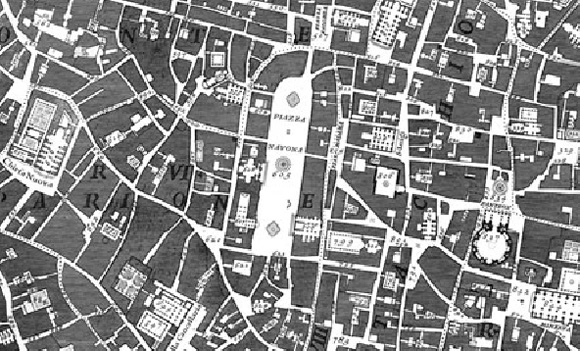
Image taken from the Nolli Map Engine 1.0 by James Tice and Eric Steiner
You guessed it, this is the ultimate claim of objectivity implemented in the plan. However, usually it is claimed o be in use only for visualisation and communication purposes. Nevertheless it also contains the implementation of truth and the establishment of power through the plan.
Bill Hillier describes space in his book ‘Space is the Machine’ 1996 as: “Space is, however, a more inherently difficult topic than physical form, for two reasons. First, space is vacancy rather than thing, so even its bodily nature is not obvious, and cannot be taken for granted in the way that we think we can take objects for granted” (Hillier 1996, p 26). He continues however with “Space is quite simply, what we use in buildings” (Hillier 1996, p 28). And finally he comes up with an astonishing example of a spatial description (and this is the reason it stands in this context to the Nolli plan).
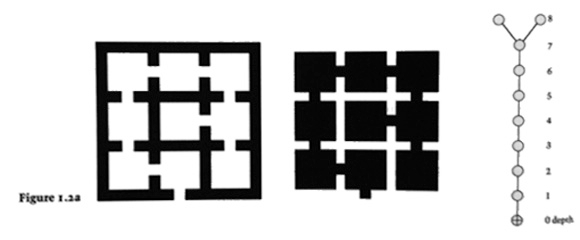
Image by Hillier, taken from Space is the Machine, Fig 1.22 on page 30
For me this image represents two things. For one this is the statement of intent to follow the tradition of the Nolli figure-ground representation as the visualisation for space, and secondly it raises the question of what exists outside the black line. To some extend, I think, the question is answered with the implied assumption that space is taken in a Euclidean sense as a container, a box that you can put things in and arrange them - boxSpace.
In architecture many famous example of the employment of the Nolli Plan can be found. See for example Ado Rossi.
His take on architecture and the representation has largely influenced the Soglio study and the in this context developed representation techniques. The study on alpine architecture in the village of Soglio in Switzerland was conducted by the Institute of Architecture of the University of Applied Science Basel and lead by Michael Alder.
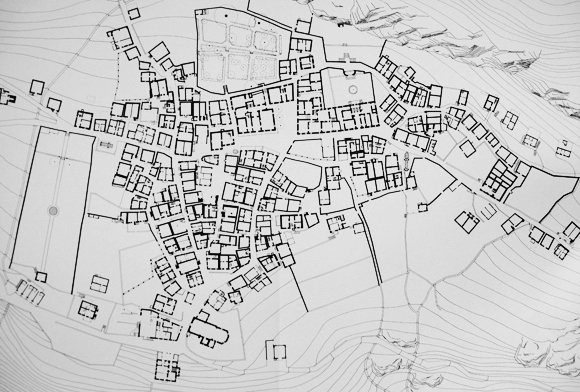
Image taken from ‘Soglio - Siedlungen und Bauten’ - Ground Floor whole settlement
This example takes the idea of figure-ground to the level of the settlement. It completely relies on the rule of accessibility as the guide for spatial representation. In this sense it is what Hillier is talking about in his example. Space is the vacancy between for the human body impenetrable material (I should say object here I guess). In this sense you could probably also call it an accessibility map or a walking guide.
This is then how Hillier introduces the space syntax concept of space description, as a sequence of, for the human body, accessible spaces.
He says: “...related space, almost by definition, cannot be seen all at once, but require movement from one to other to experience the whole” (Hillier 1996, p 26). Interesting here for me is that to some extend this raises some critique on the figure-ground idea of space, as it employees movement ‘to experience the whole’. But more of this in a following post.
As a physical manifestation of this concept here an example I recently came across on A Daily Dose of Architecture. In some sense this is the above space Box concept in built, including the fabrication and installation process.
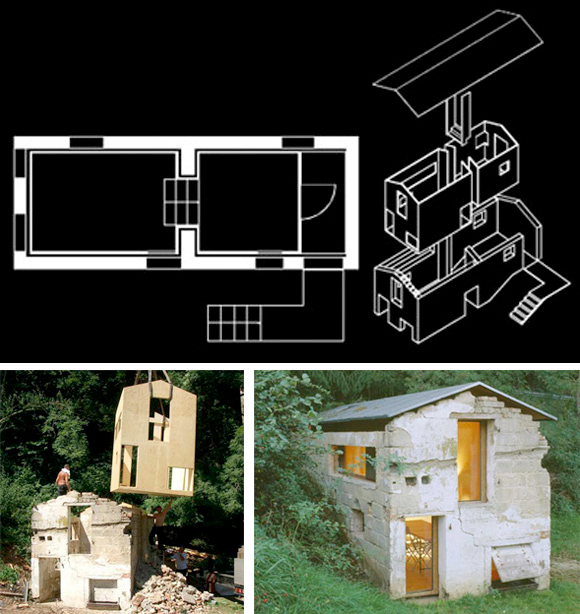
Images by FNP - The project ‘S(ch)austall’ as published by DBZ-online
Alder, M. & Giovanoli, D., 1997. Soglio: Siedlungen und Bauten / Insediamenti e construzioni 2nd ed., Birkhäuser Basel.
Hillier, B., 1996. Space Is the Machine: A Configurational Theory of Architecture, New York: Cambridge University Press.
I would like to start with the widely accepted idea of the figure ground representation of built form. I believe this technique is derived from the Nolli plan of Rome, invented by Giambattista Nolli and published in 1748. In essence it is the representation of physical form in black, leaving the void (space) in between white.
Image taken from the Nolli Map Engine 1.0 by James Tice and Eric Steiner
You guessed it, this is the ultimate claim of objectivity implemented in the plan. However, usually it is claimed o be in use only for visualisation and communication purposes. Nevertheless it also contains the implementation of truth and the establishment of power through the plan.
Bill Hillier describes space in his book ‘Space is the Machine’ 1996 as: “Space is, however, a more inherently difficult topic than physical form, for two reasons. First, space is vacancy rather than thing, so even its bodily nature is not obvious, and cannot be taken for granted in the way that we think we can take objects for granted” (Hillier 1996, p 26). He continues however with “Space is quite simply, what we use in buildings” (Hillier 1996, p 28). And finally he comes up with an astonishing example of a spatial description (and this is the reason it stands in this context to the Nolli plan).
Image by Hillier, taken from Space is the Machine, Fig 1.22 on page 30
For me this image represents two things. For one this is the statement of intent to follow the tradition of the Nolli figure-ground representation as the visualisation for space, and secondly it raises the question of what exists outside the black line. To some extend, I think, the question is answered with the implied assumption that space is taken in a Euclidean sense as a container, a box that you can put things in and arrange them - boxSpace.
In architecture many famous example of the employment of the Nolli Plan can be found. See for example Ado Rossi.
His take on architecture and the representation has largely influenced the Soglio study and the in this context developed representation techniques. The study on alpine architecture in the village of Soglio in Switzerland was conducted by the Institute of Architecture of the University of Applied Science Basel and lead by Michael Alder.
Image taken from ‘Soglio - Siedlungen und Bauten’ - Ground Floor whole settlement
This example takes the idea of figure-ground to the level of the settlement. It completely relies on the rule of accessibility as the guide for spatial representation. In this sense it is what Hillier is talking about in his example. Space is the vacancy between for the human body impenetrable material (I should say object here I guess). In this sense you could probably also call it an accessibility map or a walking guide.
This is then how Hillier introduces the space syntax concept of space description, as a sequence of, for the human body, accessible spaces.
He says: “...related space, almost by definition, cannot be seen all at once, but require movement from one to other to experience the whole” (Hillier 1996, p 26). Interesting here for me is that to some extend this raises some critique on the figure-ground idea of space, as it employees movement ‘to experience the whole’. But more of this in a following post.
As a physical manifestation of this concept here an example I recently came across on A Daily Dose of Architecture. In some sense this is the above space Box concept in built, including the fabrication and installation process.
Images by FNP - The project ‘S(ch)austall’ as published by DBZ-online
Alder, M. & Giovanoli, D., 1997. Soglio: Siedlungen und Bauten / Insediamenti e construzioni 2nd ed., Birkhäuser Basel.
Hillier, B., 1996. Space Is the Machine: A Configurational Theory of Architecture, New York: Cambridge University Press.
Selasa, 17 November 2009
New City
To continue from the post on the origin of architecture, which I have to admit wrote in a haste, there is an interesting talk by Greg Lynn on his project ‘New City’. It continues the debate with a lot of critique on the contemporary state of the city, but especially critique on the way the city is thought of, not only if we take virtual representations as indicators of the general understanding of urban aspects.

Image by imaginary forces - Screenshot taken from NewCity clip - the New City toroids.
Earlier this year Greg Lynn has given a talk that was broadcasted in the Seed Design talks series with the title ‘New City’. He was talking about a recent project he had on exhibition at the MoMa. It was the idea of developing a virtual world from an architectural point of view. His analysis of existing spatial and especially architectural representation in virtual worlds is quit interesting. I do not really have virtual world experience, like Second Life or something, but this is to some extend down to the visual representation. To me the graphics are simply ridiculous, why should I use this to represent my virtual self if I cannot identify myself with it? I can however identify with the graphical language used by Lynn. But then I think, this represents a very specific social grouping thorough factors like, culture, education, background, financial situation, location and so on. Whether you choose one over the other is not an as free decision as we might like to think of it as.
However this might be a side line of the debate, in terms of the evolution it is obvious that Lynn very cleverly positions his work in this context. His introduction makes good use of and plays well with the expectations of the audience. He knows exactly what this social group is looking for.
The most interesting aspect Lynn is talking about in this presentation to me is his critique on the spatial configuration. He says: “The world is not...ah..its not a globe. I mean I do think... I, I, do think Google Earth is fabulous, but the idea that you go on the internet to see what the world looks like and you find this kind of 15th Century globe sitting there, that you spin around on it on an axis, is ... is very strange to me. (at 05.50 in the seeds clip”
So what the come up with is a series of rings called toroids, that are interlocked to replace the globe. it is an interesting idea and has a logic to it as he is talking about it. However there is definitely critique in terms of space, distance, separation and so on. However the visualisations are pretty sexy and this is probably what it needs to be.
However what I am really not convinced by is the actual representation of architecture. This has a long way to go. It looks at the moment like space box renderings. They are following a gravity model to structure activities, but the dealing with the actual form of something needs to be developed.
Especially in the context of the concepts of space and time as social conventions. The current model of space and time could be described as being based on the idea of a market place as the definition of a location and a time. However this would also needed to be radically rethought in this proposal, especially as Lynn introduces this new city as “a new sort of encyclopedia”. This would move the framework from the trade focus towards a focus of knowledge and this might generate a space time construction based on the library as the location and the past as the time.
However have a look at the talk it is only 20 something minutes so a good clip for the lunch brake.
Rabu, 28 Oktober 2009
Der Mensch als Industriepalast - Animation
I am currently very fascinated by everything machine. We’ll as you can guess or experience your self there is very little that would not fall into this category, in terms of conception. However this might also simply be a preconditioned view through the glasses of the ticking ticking ticking blog topic with the idea of cycles and rhythms.
What ever it is here is an update to an other post on the human machine, referring to concepts picturing the body as a machine. Famously Fritz Kahn stands for the most complete work of this idea.

Image by Anatomies by Fernando Vicente - Illustration in the style of Fritz Kahn
However there is a beautiful project by Henning Lederer to animate the drawings of Fritz Kahn and brings them to life. It was produced as an university Master project, details on HERE. Detailed project information can be downloaded as a PDF. Henning also writes a very fascinating blog on everything related to the topic of machines and animation with a string of beautiful examples.
What ever it is here is an update to an other post on the human machine, referring to concepts picturing the body as a machine. Famously Fritz Kahn stands for the most complete work of this idea.
Image by Anatomies by Fernando Vicente - Illustration in the style of Fritz Kahn
However there is a beautiful project by Henning Lederer to animate the drawings of Fritz Kahn and brings them to life. It was produced as an university Master project, details on HERE. Detailed project information can be downloaded as a PDF. Henning also writes a very fascinating blog on everything related to the topic of machines and animation with a string of beautiful examples.
Der Mensch als Industriepalast [Man as Industrial Palace] from Henning Lederer on Vimeo.
Langganan:
Postingan (Atom)