Tampilkan postingan dengan label Google Latitude. Tampilkan semua postingan

Kamis, 03 Februari 2011

Latitude is Not Dead - Checking in is Taking Over the World

As Google introduced Google Buzz back in 2009 they simply delivered it straight past the existing location based service. Back then, the introduction came with a bang an Google put a lot of effort pushing into the location based application segment. Even though Google basically has a monopole on everything location based, one year on Buzz has been sleeping for most of its existence.

Services popping up, mainly Goala and Foursquare raised instead. With it a whole bunch of similar apps like Brightkite and later in 2010 also facebook managed to more or less successfully integrate the location feature into the platform.

Foresquare released some stats last month claiming a growth of 3400% in the past year! Not sure what exactly this means, but generally it can be said that this sort of application is currently very popular amongst smart phone users. What I haven't seen so far are gender stats on how girls and boys compare in the usage of location based self tagging. From my experience, not at all empirical, when ever I check in at a facebook place, there seem to be a lot more boys already checked in at this place than girls. Maybe I am in the wrong place, but maybe its a boys thing.

foursquare stats
Graph taken from foursquare / Honestly, 2010 was just insane. The numbers tell the story better than we can, so we put together this little infographic. (Also, our 6,000,000th user signed up last week!) See similar twitter stats in this earlier post HERE.

Anyway, here comes Google and resurrects Latitude from the dead (see earlier post on the death of Latitude HERE) to play alongside these platforms letting users check in. This, for those who have missed the short earlier live of Latitude, is quite a development from what L was at the beginning. It was a location sharing platform based on location not venue. Al you coud see was the dots of your friends on the map. Of course this was a major inovation back then and it was one of the first large scale applications of this kind. It was cool, but noone understood it. There was just too much negative press and too many concerned voiced tearring it all back down for Google, only to make way for the 'younger' generation of app that are now this successful.

Privacy concerns were at the forefront of the discussion and one of the odd things that was introduced by Google was a reminder message, sent roughly every two weeks to respond to concerns about people knowing the where abouts of a person without his or her knowing. I still receive this message I guess.
Hopefully Google has now stopped sending them, this would clutter the mailboxes of the potentially now growing user group unnecessarily.
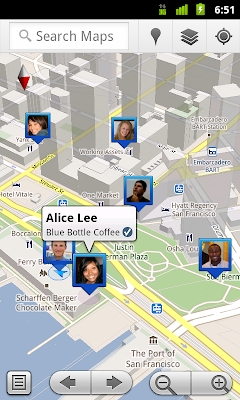
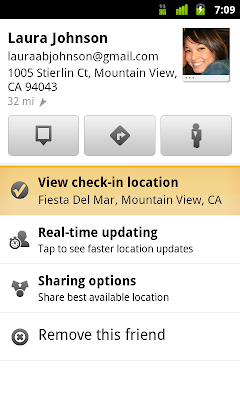
New Latitude New Latitude
Images taken from Google Lat Long Blog / See where your friends are on a map and where they’re checking in. Latitude check-ins are built right into Google Maps and Place pages.

The new service lets people check in at locations and also, this is new, check out. There are various options for automatic check in or reminders to check in and so on. I especially like the line in the promotion clip where it says "you can automatically check in, there is no need to interrupt the conversation to let your friends know that you have checked in."

The new app has so far only been released for the new Android 1.6 and runs on the updated Google Maps 5.1 iPhone users can so far only use the updated Latitude version 2.01, where the locations of your friends are visible, but for yourself the check in function is not yet available. More details on the Google Blos Official Blog and Mobile Blog.

Selasa, 23 Februari 2010

A Buzz for the iPhone - Latitude is Dead

Google seemed for a long time to kind of miss the upcoming social networking hype. They have actually paved the way for this development to happen, especially where it comes to location based services and now it looks like they miss the train.
This is not the first time though, already with the chat they could not catch up with msn or with voip, skype was the number one. Same here again with social networking, Google had to watch the rise of facebook and twitter for quite a while and similar with the location based social networking services. Here Brightkite or foursquare are small, but very agile and successful providers of location based services. Earlier these services were discussed HERE.
Google came up with the Google Latitude service. It offers the option to let a mobile device track its route and broadcast it on the web or share with invited friends. It was a very simple platform and did not offer anything in addition. Were Brightkite offered tools for networking, commenting and socializing, Latitude would only show a the location. This inability not to interact could be frustrating and this might be the reason why Latitude stayed a niche product.
But Google was determined to come up with some sort of service to mach the still growing social networking community. So earlier this month they launched Google buzz, sort of an extension to Gmail. Google buzz was introduced on their official blogs HERE or HERE or on googlemobile.
It is kind of a cross between a chat and micro blogging tool that can be used directly from within Gmail. It combines elements of Gmail, Wave and Latitude, looks a bit like facebook (in the way it displays the activities) and works a bit like twitter (the way you can sign up and follow other users). There are however also differences. It is tied to the Gmail account, which means no strange names or funny images. It automatically links to everyone you have ever emailed through Gmail, your identity is set. Also the fact that it is embedded in Gmail means you have to be inside your mailbox to use it and follow your friends (for now, there will be for sure other clients pop up - depending how it develops).
I have to say for me is the Gmail integration at the moment not the most interesting part, but rather a bit annoying. I very seldom log in to check my email. In fact I basically have only joined buzz because I am logging in to the Gmail service at the moment due to a faulty machine and I don't have access to my regular mail client. But lucky me, the real deal with the Google buzz is the way it works on mobile clients such as the iPhone. Blogs, for example the next web, have this week described the service, what twitter should be, or what the next generation facebook with integrated location awareness must be! And really this is it, buzz mobile, in this case one could say it is an extended Google Latitude, gives you the service you'd expect. In a list or on the map you see the buzz's around you and you can interact with them. Nothing new, yes we know, Brightkite or Foursquare do this for a year already, but twitter doesn't yet properly do this.
THe main problem really is the graphical interface. I know this is a tricky one, but I really can't get warm with this Google style. This was already one of my main complaints with Google Wave and now it is again with Google buzz. It is simply ugly and unfriendly. It might work properly, but if it aint good looking you don't want to use it. Compared to twitter or facebook , similar complaints apply there too and the boring design of facebook is one of the reasons I hesitated long before starting to use it. Twitter is a different case. It took me a while to get used to it, but they managed to develop their own stile and invented a format for micro blogging.
To come back to the actual functions of the buzzing buzz, it is integrated with Gmail as mentioned above, so direct buzzing is easy, even more Google has integrated the buzz button on the search page too. So as you have found something while searching, simply click the buzz button and your very personal news go out to the world. Similar with the location based integration, Google makes the most of the services they already have and are successful. They have added a buzz layer to Google Maps for example, where you can see what is buzzed around a certain location. For a more complete list on the features and how to use them see mashtrends. The map feature is great and you get quick and simple an impression of what is going on in an area. This, however, creates an interesting problem of how to represent the aspect of time. At the moment this is not really a question, but soon certain places will become very buzzy and it will become impossible to decide which buzz you actually want to see. It was similar with the user generated KML files that would be automatically be integrated into the general Google Earth layer in the early days of Google Earth. It obviously quickly grew to be too much user generated information and Google started selecting. By now the have established 'official' layer contributors, such as Panoramio or Discovery Channel. But here, with Google buzz, the aim is different n so should be the solution. How can Google simplify the growing content without losing the important content you are looking for? There are aspects of time involved, beside possible categories or tags. A feature like the timeline in Google Earth would be a good start, to see how this location developed and where the information lies that one is looking for.
Anyway, if other clients start picking up the format it might all change, at least this is what was the promise with Google Wave, we'll see. For now there is a new Google buzz button with each post here on the blog, so keep buzzing away, it could develop into something.